
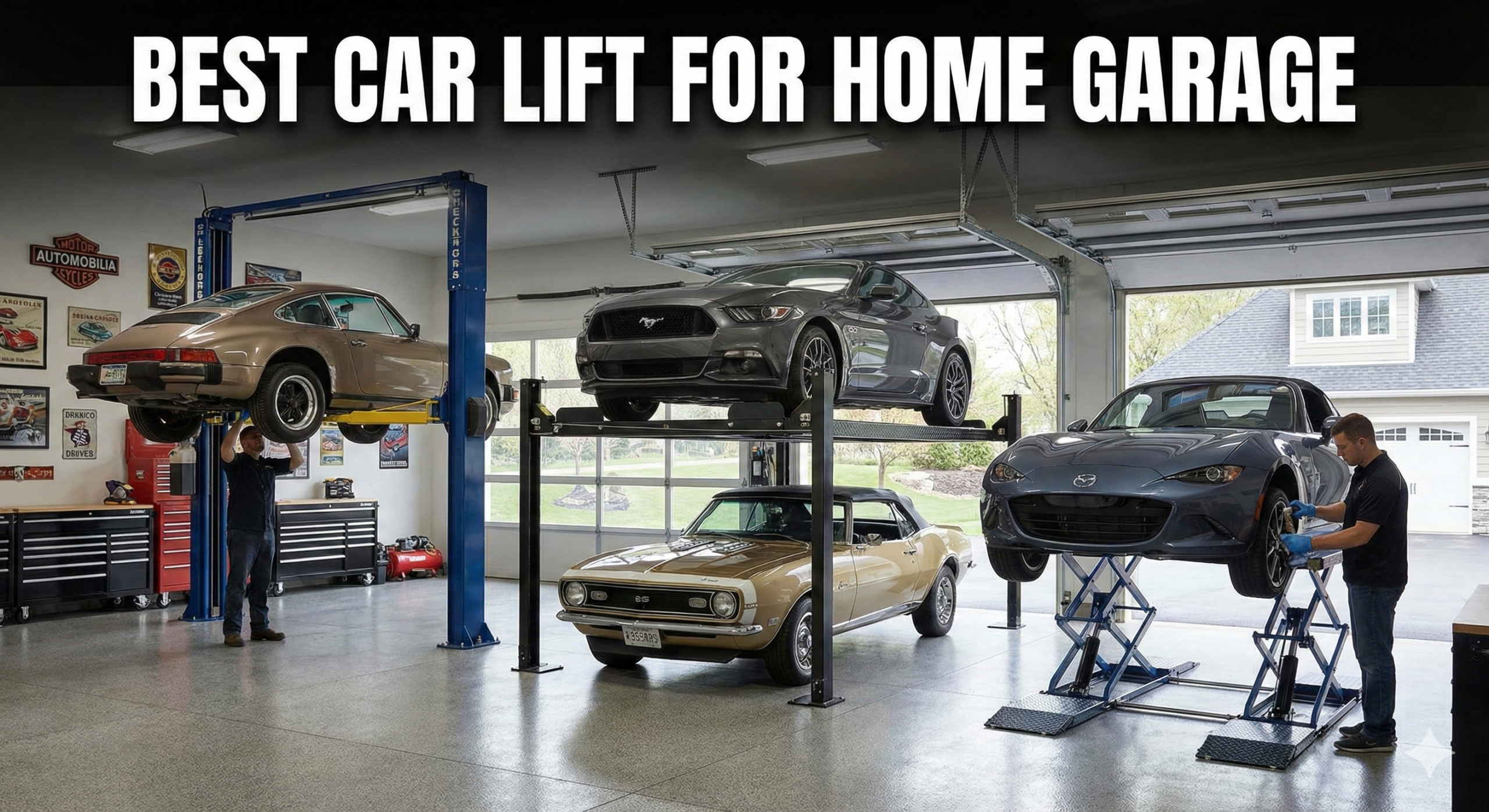
Introduction: Elevating Your Home Garage
For the automotive enthusiast, the home garage is more than a parking spot—it is a sanctuary. But nothing limits a workspace quite like gravity. Whether you are performing a transmission swap, detailing a rocker panel, or simply trying to squeeze a second vehicle into a single bay, a car lift is the ultimate force multiplier.
However, the market is flooded with options that look similar but function differently. Choosing the “best car lift for home garage” setups depends entirely on your specific mission. Are you a wrencher needing suspension access? A collector needing storage? Or a detailer needing portability?
This comprehensive guide breaks down the three primary categories of residential lifts: Under Car (Scissor/Portable), 2-Post, and 4-Post. We will analyze the mechanics, installation demands, and pricing of each to help you make the right investment.
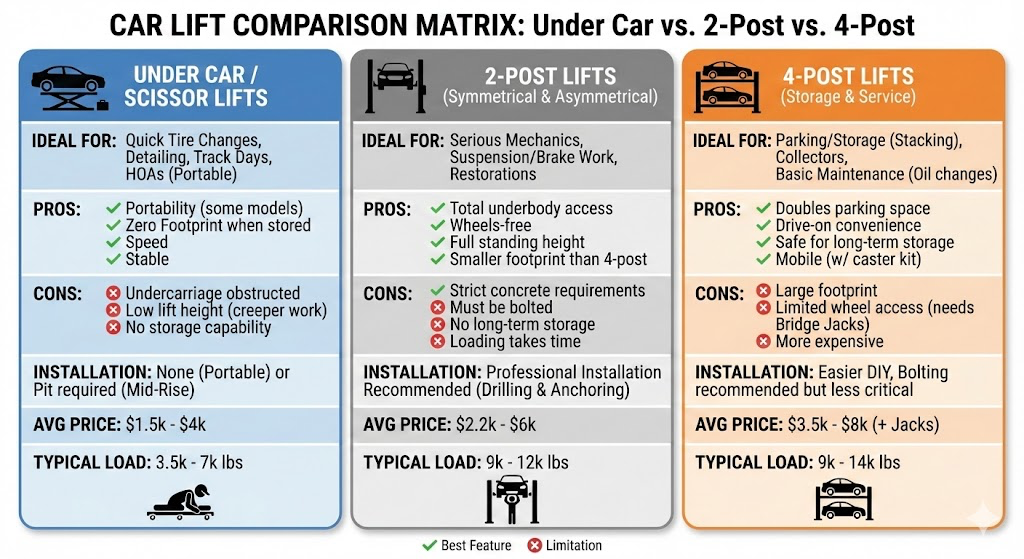
At a Glance: The Three Contenders
Before diving deep, it is helpful to understand the fundamental mechanical differences.
- Under Car / Scissor Lifts: These are often portable or low-profile units that slide under the vehicle’s frame points.They lift from the center, pushing straight up.
- 2-Post Lifts: The professional standard. Two vertical columns are anchored to the floor, using swing arms to lift the vehicle by its frame. This leaves the wheels hanging free.
- 4-Post Lifts: The storage king. Four columns support two runways (ramps). You drive the vehicle onto the ramps, and the entire platform rises. The vehicle rests on its tires.
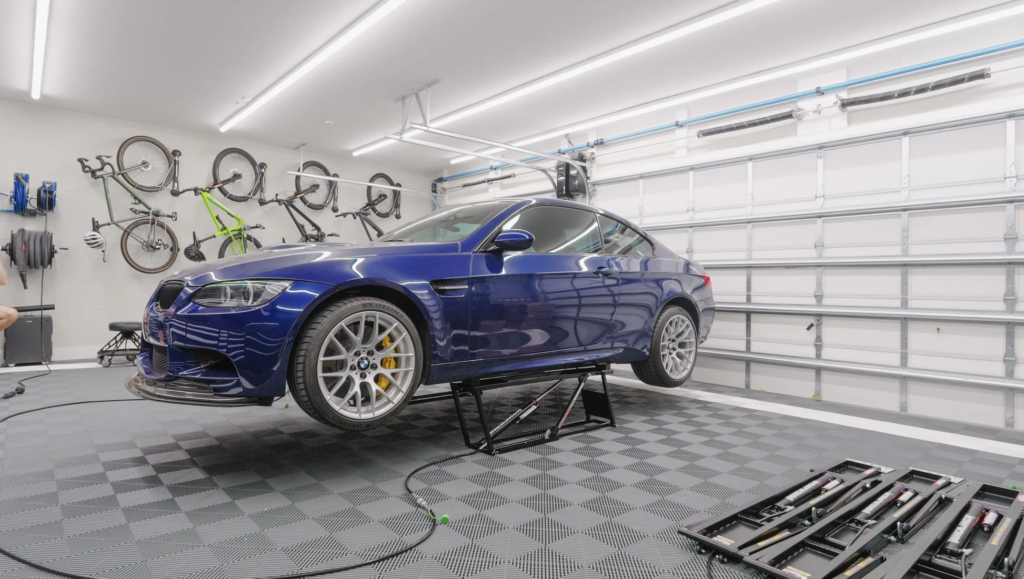
Deep Dive: Under Car & Scissor Lifts
What Are They?
Under car lifts are the chameleons of the garage world. They are defined by their ability to collapse flat (or near flat) on the floor, disappearing when not in use. Unlike post lifts, they lift from the bottom up, pushing against the vehicle’s frame or lifting points.
However, grouping them all together is a mistake. There are two distinct categories that function very differently: the Portable Frame-Engaging Lift and the Mid-Rise Scissor Pad.
1. Portable Frame-Engaging Lifts (The “QuickJack” Style)
This category has revolutionized home wrenching in the last decade.
- Design: These systems consist of two separate, lightweight frames—one for each side of the car. You slide them under the rocker panels, connect hydraulic hoses to a small portable power unit, and press “Up.”
- The “Open Center” Advantage: Because the two frames are not connected by a crossbar, the entire center of the vehicle remains open. This is a game-changer. Unlike traditional scissor lifts, you can drop a transmission or exhaust system with this setup.
- Movement: These lifts typically use a parallelogram action. As the lift rises, the car moves slightly forward or backward (about 12 inches). You must account for this “arc” so you don’t push your car into the garage door or work bench.
- Storage: The frames usually have wheels on one end. When you are done, you can hang them on the wall or slide them under a low-profile car.
2. Mid-Rise Scissor Lifts (The “Tire Shop” Style)
These are heavy-duty, single-unit lifts often seen in fast-lube or tire shops (e.g., BendPak MD-6XP or Twin Busch).
- Design: A large steel platform (or H-frame) sits on the floor. You drive the car over it, swing out the arms or position rubber blocks, and the lift scissoring mechanism pushes straight up.
- The “Closed Center” Issue: The lifting mechanism and hydraulic cylinders occupy the space directly under the center of the car. While great for wheel and brake work, this blocks access to the transmission, driveshaft, and mid-pipe exhaust.
- Stability: Because it is a single, heavy unit (often 1,000+ lbs), it is incredibly stable. It lifts higher than portable units (often 48+ inches) and lifts strictly vertically—no forward/backward arc.
- Installation: These are not truly “portable.” You park over them. If you want a flush floor, you have to cut a pit into your concrete and recess the lift, which is a major construction project.
3. Full-Rise Scissor Lifts
- Design: These look like mid-rise lifts but extend all the way to 6+ feet, allowing you to stand up.
- The Catch: They are expensive and require significant floor prep (usually a flush-mount pit) to be practical in a home garage. If not recessed, you need long approach ramps to get a low car over the collapsed mechanism (which can be 5-10 inches tall).
Pros
- Portability (Portable Models): This is the only option for renters, HOA neighborhoods where open garage doors are monitored, or driveways. You can use it, pack it up, and hide it in 10 minutes.
- Zero Footprint: When collapsed, you can park right over them (Mid-Rise) or hang them on the wall (Portable). You lose zero square footage in your garage.
- Safety: They are generally very stable because the center of gravity remains low and the base is wide.
- Speed: Much faster than using a floor jack and four jack stands.
Cons
- Lift Height: Most max out at 20–24 inches (Portable) or 48 inches (Mid-Rise). You won’t be standing under the car; you will be working from a rolling stool or a creeper.
- Undercarriage Obstruction (Mid-Rise only): As noted, the solid deck blocks the transmission tunnel.
- Setup Friction: With portable units, you still have to drag them out, position them, and hook up hoses every time you want to use them. It’s easier than jack stands, but harder than driving onto a 4-post lift.
Who Is This For?
- The Track Day Enthusiast: Needs to swap tires and pads quickly at the track or in the driveway.
- The Detailer: Needs the car at waist height for polishing side panels and cleaning wheel wells.
- The Small Garage Owner: Has a standard 8-foot ceiling and no room for columns.
Who Is This NOT For?
- Anyone looking to stack cars for storage (you cannot park a car underneath a scissor lift).
- Mechanics who demand “standing room” work environments.
Pricing & Specs
- Price Range: $1,500 – $2,000 (Portable); $2,500 – $4,500 (Mid-Rise/Full-Rise).
- Load Capacity: Typically 3,500 lbs to 7,000 lbs. Note: Heavy ¾-ton trucks often exceed the capacity or wheelbase length of portable units.
- Recommeded: QuickJack 8000T
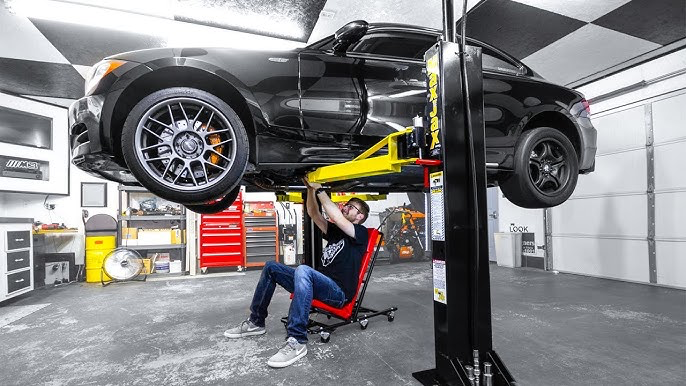
Deep Dive: 2-Post Car Lifts
What Are They?
If you walk into any professional ASE-certified mechanic shop, this is what you see. Two columns, four arms, and total underbody freedom. The vehicle is lifted by its frame or designated jack points, leaving the suspension to hang freely. This makes the 2-post lift the gold standard for maintenance and repair.
However, not all 2-post lifts are the same. To choose the right one, you must understand the Column Orientation and the Cable Routing.
1. Column Orientation: Symmetrical vs. Asymmetrical
The way the columns are angled determines how you load the car and how easily you can get out of it.
- Symmetrical Lifts (The Heavy Lifter):
- Design: The columns face each other directly squarely. The vehicle is loaded so that its center of gravity is perfectly centered between the posts. The front and rear lift arms are typically the same length.
- Best For: Long-wheelbase trucks, vans, and heavy SUVs. Because the weight is perfectly centered, this is the most stable configuration for heavy loads.
- The Downside: The columns are positioned right next to the front doors. If you have a wide vehicle, you might not be able to open the doors to get out once you drive in.
- Asymmetrical Lifts (The Daily Driver):
- Design: The columns are rotated slightly (usually 30 degrees) toward the rear of the bay. The vehicle is pulled further back (about 30% of the car is in front of the columns, 70% is behind). The front arms are shorter, and the rear arms are longer.
- Best For: Passenger cars, sedans, and light trucks.
- The Upside: The rotation and rear-shifted position allow you to open the driver’s door fully without hitting the column. This is a massive quality-of-life feature for home mechanics.
- Versymmetric (The Hybrid):
- Some premium brands (like BendPak or Rotary) offer “Versymmetric” or adjustable lifts that can be configured in either mode, or use 3-stage arms to mimic both styles. These are more expensive but offer maximum versatility.
2. Cable Routing: Clearfloor vs. Floorplate
This is the second most critical decision, dictated largely by your ceiling height.
- Clearfloor (Overhead) Models:
- Design: The hydraulic lines and equalization cables run across the top of the lift, connecting the two columns via a crossbar.
- Pros: The floor between the columns is completely flat. You can roll transmission jacks, oil drains, and tool carts underneath without obstruction. It looks cleaner and more professional.
- Cons: You need a high ceiling. The crossbar typically sits at 12 feet or higher. If you have a standard 9 or 10-foot ceiling, this simply won’t fit.
- Floorplate (Baseplate) Models:
- Design: The lines and cables run along the floor, covered by a low-profile metal plate (about 1-2 inches tall).
- Pros: Perfect for low ceilings. The columns are usually shorter (around 9-10 feet), fitting in standard residential garages where an overhead bar would hit the rafters.
- Cons: The floorplate is a “speed bump.” It makes moving jacks and equipment under the car annoying. It can also trap dirt and grease, requiring more cleaning.
3. Arm Design: 2-Stage vs. 3-Stage
The “arms” are the telescoping steel beams that swing out to grab the car.
- 2-Stage Arms: An outer tube and an inner extension. These are standard on cheaper lifts. They have a limited reach range.
- 3-Stage Arms: These have an extra telescoping section. They can retract shorter to pick up small cars (like a Miata or Mini Cooper) and extend longer to reach the frame points of a long-bed truck. If you work on a wide variety of vehicles, 3-stage arms are a must-have upgrade.
Pros
- Total Access: The wheels hang free. This is non-negotiable for suspension work, brake jobs, and tire rotations.
- Space Efficiency: It has a smaller footprint than a 4-post lift.
- Height: You can stand completely upright under the vehicle (ceiling permitting).
Cons
- Strict Installation Requirements: These must be bolted to the floor. If your concrete is thin or cracked, you cannot use this lift.
- Parking/Storage Issues: You typically cannot park a second car underneath for long periods. The suspension of the lifted car hangs, which is bad for bushings over months of storage. Plus, fluid drips from the top car will hit the bottom car unless you rig up a custom tarp.
- Loading Difficulty: You must get on your knees to position the arms on the lift points every single time.
Who Is This For?
- The Serious Mechanic: You do engine swaps, clutch jobs, and suspension tuning.
- The Restorer: You need access to every inch of the frame and floor pans.
Who Is This NOT For?
- The “Storage First” user who just wants to park a Corvette over a daily driver.
- Garages with poor concrete quality (less than 4 inches depth or 3000 PSI).
Pricing & Specs
- Price Range: $2,200 – $6,000.
- Load Capacity: 9,000 lbs to 18,000+ lbs. Standard home units are usually 10,000 lbs.
- Recommended: BendPak 10AP Lift
Deep Dive: 4-Post Car Lifts
What Are They?
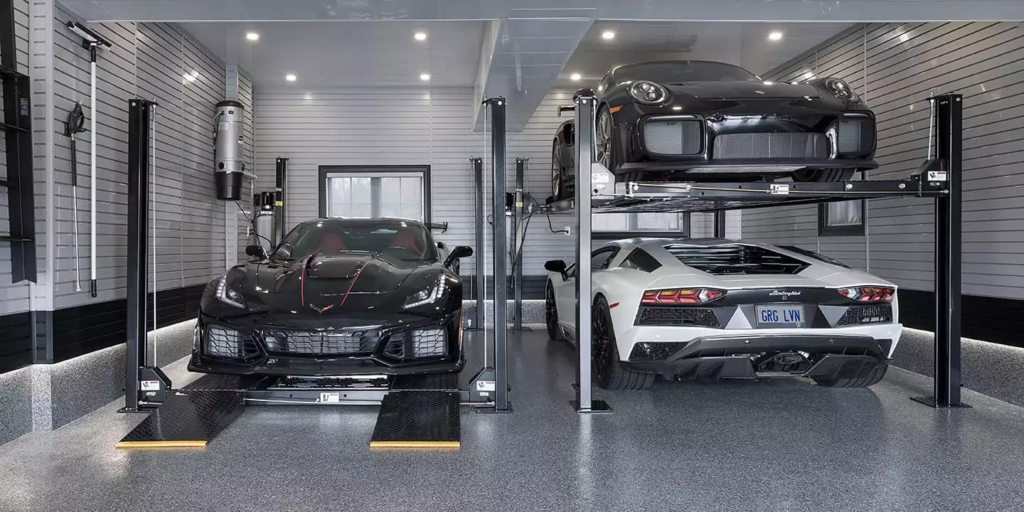
The 4-post lift is the “lifestyle” king of the garage world. It consists of four columns supporting two runways (ramps). You drive the vehicle directly onto the tracks, and the entire platform rises. Because the vehicle rests on its tires, there is no need to kneel down and position lift arms.
While 2-post lifts are for fixing cars, 4-post lifts are primarily for storing them—though with the right accessories, they can do double duty. To pick the right one, you need to understand Length/Width configurations, Locking Systems, and the Bridge Jack ecosystem.
1. Configuration: Standard vs. High/Wide
You cannot just buy a “standard” 4-post lift and assume your truck fits.
- Standard Width: These are designed for typical sedans and sports cars. The runways are narrower, and the distance between the posts is tighter.
- Extra Wide/Tall: If you plan to park a Ford Raptor, a dually, or a wide-body supercar, or if you want to drive a wide trailer through the lift, you need a “Wide” model.
- Runway Length: This is the most common mistake buyers make. A standard lift might have 165-inch runways. A crew-cab long-bed truck can easily exceed 250 inches. If your wheelbase is too long, your tires will hang off the back. Always measure your longest vehicle’s wheelbase before buying.
2. Locking Systems: Manual vs. Pneumatic (Air)
How do you unlock the safety latches to lower the car? This is a major usability difference.
- Manual Linkage (Single Point Release): You pull a single lever on the main post, and a system of metal rods physically pulls the locks open on all four corners.
- Pros: Simple, reliable, no external power needed.
- Cons: The linkage rods can be finicky to adjust during installation.
- Pneumatic Locks (Air Release): The industry standard for premium lifts (like BendPak). You press a button, and a small air cylinder at each post releases the lock.
- The Catch: You need an air compressor. It doesn’t need to be big (a small 5-gallon pancake compressor works), but it must be plumbed to the lift. If you don’t have air in your garage, this adds to the installation complexity.
3. The “Bridge Jack” Factor
A basic 4-post lift is terrible for wheel and brake work because the car is sitting on its tires. To fix this, you need Rolling Bridge Jacks.
- What are they? Hydraulic jacks that sit between the runways. You slide them under the car’s axles and lift the car off the runways.
- The Cost: They are expensive—typically $1,200 to $1,800 per jack. To do a 4-wheel tire rotation, you need two of them. This can nearly double the price of the lift.
Pros
- Parking & Storage: This is the safest way to stack cars. The vehicle rests on its suspension, which is how it was designed to sit.
- Drip Protection: You can place plastic drip trays between the runways to prevent oil from the top car ruining the paint of the bottom car.
- Mobility (Caster Kit): Surprisingly, most hobbyist 4-post lifts can be moved. A “Caster Kit” allows you to lift the lift itself onto wheels and roll it around the garage (while unloaded). This is impossible with a 2-post lift.
- Installation Tolerance: Because the weight is distributed over four columns, the concrete requirements are less strict. In fact, many 4-post lifts are “free-standing” and do not technically require bolting to the floor (though bolting is always safer for earthquake/impact stability).
Cons
- Footprint: It is massive. A 4-post lift effectively consumes a standard parking spot permanently. It feels much larger in a room than a 2-post lift does.
- Ramp Management: To get the car on, you need approach ramps. Steel ramps are heavy (40+ lbs each) and must be removed and stored every time you want to walk under the lift or park a car underneath. Pro Tip: Upgrade to Aluminum ramps if your back is bad.
- Cost: Generally more expensive than 2-post lifts due to the sheer amount of steel involved.
Who Is This For?
- The Collector: You have more cars than garage spots and need to “double stack.”
- The DIYer: You mostly do oil changes, exhaust work, and detailing.
- The Renter: If you move, you can disassemble it and take it with you easily, without leaving massive anchor holes in the concrete.
Who Is This NOT For?
- Mechanics who primarily do brake, suspension, and tire work (unless you are willing to spend big money on bridge jacks).
Pricing & Specs
- Price Range: $3,500 – $8,000 (Lift only); Add $1,500 – $3,000 for Bridge Jacks.
- Load Capacity: 7,000 lbs to 40,000+ lbs. Standard home units are 9,000 lbs.
- Recommended: APlusLift 4 Post Car Lift
Critical Comparison: Installation & Requirements
This is where most home garage owners make mistakes. You cannot simply buy a lift and bolt it down.
1. Concrete Requirements
- 2-Post: Strict requirement. usually a minimum of 4 inches (preferably 6 inches) of 3000 PSI cured concrete. You must not drill within 6 inches of a seam or crack. If your floor is post-tensioned cable, you cannot drill into it without X-ray scanning first.
- 4-Post: much more forgiving. While 4 inches is recommended, the stability comes from the box structure.
- Scissor: most require a flat floor, but density is less critical as the load is spread over a wide frame rail.
2. Ceiling Height
- Formula: Car 1 Height + Car 2 Height + 8 inches (lift deck thickness + safety lock clearance).
- Example: If you want to stack a Porsche 911 (52″) over a Ford Mustang (55″), you need: 52 + 55 + 8 = 115 inches (9.5 feet) minimum ceiling height.
- Overhead Hazards: Watch out for garage door openers and tracks. You may need to convert to a “High Lift” or “Jackshaft” garage door opener (mounts on the wall, not the ceiling) to clear the car.
3. Power Requirements
- 110v vs 220v:
- Most commercial-grade 2-post and 4-post lifts run on 220v single phase (requires a dedicated 30-amp breaker).
- Portable scissor lifts and some light-duty 4-post lifts are available in 110v, but they lift significantly slower (45-60 seconds vs 30 seconds).
Load Capacity: The “Truck Factor”
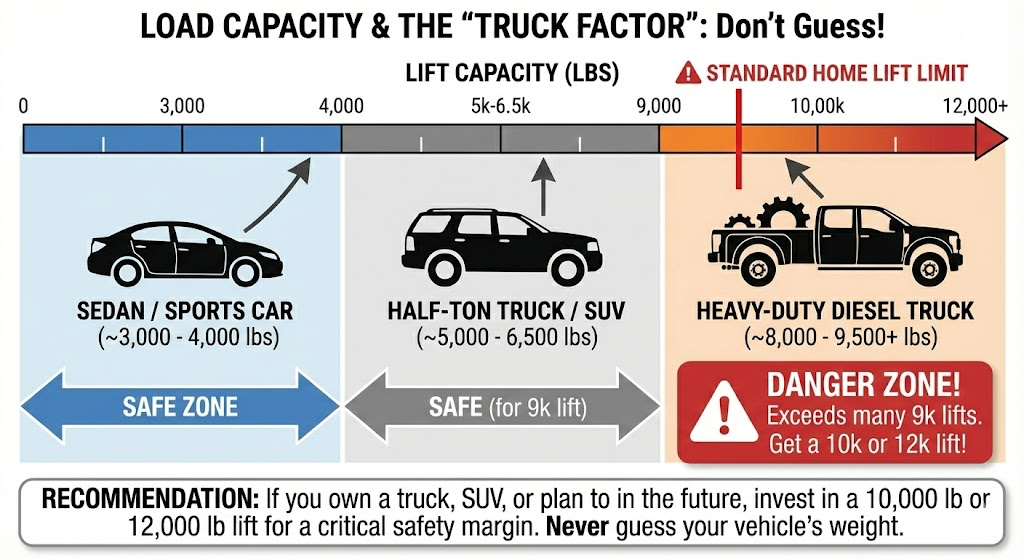
When choosing capacity, do not guess.
- The 9,000 lb Rule: Many standard home lifts are rated for 9,000 lbs.
- The Diesel Trap: A modern ¾-ton or 1-ton diesel truck (e.g., Ford F-250, Ram 2500) can weigh 8,000+ lbs empty. Once you add tools, fuel, and aftermarket bumpers, you are dangerously close to the limit of a 9k lift.
- Recommendation: If you own a truck or large SUV, buy a 10,000 lb or 12,000 lb lift. The price difference is often negligible compared to the safety factor.
Final Verdict: Which Lift Wins?
Best for the “Weekend Warrior” Mechanic
Winner: 2-Post Lift (Asymmetric)
If you have the concrete depth and the ceiling height, the 2-post lift offers the best “mechanic” experience. It turns your home into a pro shop.
- Top Pick: BendPak XPR-10AXLS (10k capacity, high rise).
Best for the “Car Collector”
Winner: 4-Post Lift
If your goal is to buy more cars without building a new garage, this is the only choice. It is safe, stable, and requires less floor prep.
- Top Pick: BendPak HD-9 or Triumph NSS-8.
Best for the “HOA / Low Ceiling” Garage
Winner: Portable Scissor Lift
If you cannot drill holes or have an 8-foot ceiling, don’t force a post lift. A high-quality portable lift gets the job done for 90% of maintenance tasks.
- Top Pick: QuickJack 7000TL (handles light trucks and SUVs).
Frequently Asked Questions (FAQ)
Q: Can I install a lift myself?
A: Yes, but it is heavy work. A 4-post lift requires a forklift or a team of friends to unload from the delivery truck. A 2-post lift requires renting a hammer drill and torque wrench. Many manufacturers will void the warranty if not installed by a certified partner, so check the fine print.
Q: Do I need to insure my lift?
A: You should notify your homeowner’s insurance. Some policies require a rider for garage equipment, especially if the value exceeds standard coverage limits.
Q: What is ALI Certification?
A: The Automotive Lift Institute (ALI) certifies that a lift meets safety standards (ANSI/ALI ALCTV). Always look for the Gold Label. Cheaper, uncertified “hobby” lifts may lack safety locks or use inferior steel. Never trust your life to a non-certified lift.