What Size Air Compressor Do I Need for My Garage? (Complete 2026 CFM, PSI & Tank Size Guide)
Check the latest price, confirm compatibility with your setup, and then read our full hands-on review.
Quick verdict on the What Size Air Compressor Do I Need for My Garage? (Complete 2026 CFM, PSI & Tank Size Guide)
Quick summary
What Size Air Compressor Do I Need for My Garage? Choosing the right air compressor for your garage is one of the most confusing decisions homeowners and DIYers face. If you buy one that’s too small, it will constantly refill, overheat, and burn out. If you buy one that’s too big, you’ll overspend, waste electricity, and lose floor space. So what size air compressor do you actually need for a…
What Size Air Compressor Do I Need for My Garage?
Choosing the right air compressor for your garage is one of the most confusing decisions homeowners and DIYers face. If you buy one that’s too small, it will constantly refill, overheat, and burn out. If you buy one that’s too big, you’ll overspend, waste electricity, and lose floor space.
So what size air compressor do you actually need for a home garage?
This definitive guide breaks down CFM, PSI, tank size, noise levels, duty cycles, tool requirements, and the exact size compressor needed for home garages, automotive enthusiasts, and full shops.
Let’s make sure you choose the perfect compressor on the first try.
The Exact Air Compressor Size Most Garages Need
If you want the quick answer:
- Most home garages need a 30-gallon air compressor with 5–6 CFM at 90 PSI.
- This size handles tire inflation, impact wrenches, ratchets, nailers, and general garage tasks.
But depending on the tools you plan to run, compressor requirements can change dramatically. Larger tools like grinders and paint sprayers require much more airflow.
That’s why understanding the ratings—CFM, PSI, and tank size—is crucial.
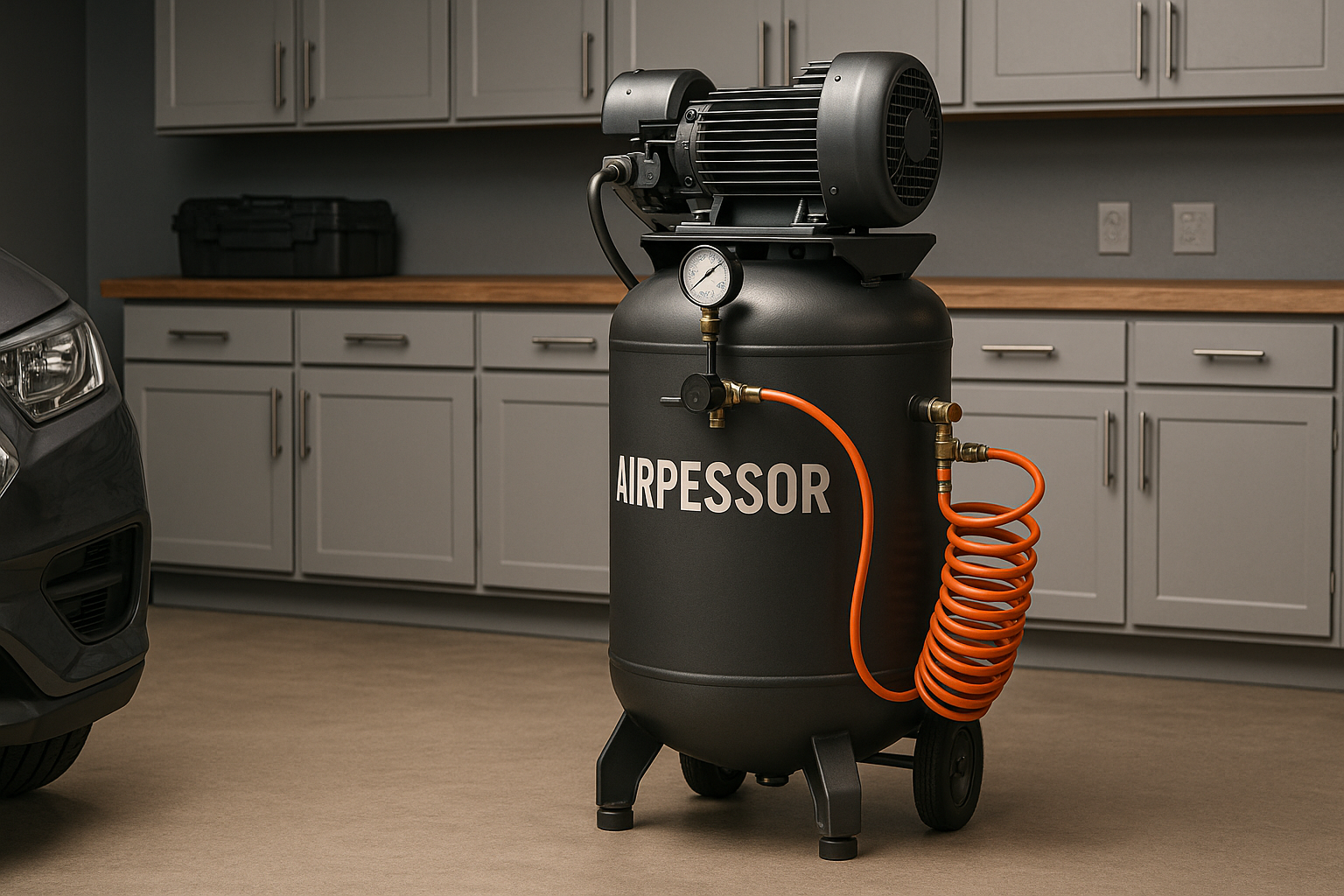
Example Mid-Size Garage Compressor (Amazon)
👉 Albott 20 Gallon Vertical Air Compressor – a quiet, vertical unit that’s a great fit for typical home garages:
Check price on Amazon
Understanding Air Compressor Ratings (CFM, PSI, Tank Size, Duty Cycle)
Air compressors come overloaded with specs that confuse beginners. Here’s what each one really means and how it affects your choice.
1. CFM (Cubic Feet per Minute) – The Most Important Spec
- CFM measures airflow output, not pressure.
- This is the number you must match to your tools.
Why CFM matters:
- Determines which tools you can run
- Determines how long the compressor can keep up
- A low CFM compressor cannot power high-demand tools
Golden rule:
Your compressor’s CFM must be equal to or higher than your tool’s CFM requirement.
If a tool requires 5 CFM, a 2 CFM pancake compressor simply won’t work.
2. PSI (Pounds per Square Inch)
- PSI measures air pressure.
- PSI is less important than CFM because nearly all compressors can output 90–120 PSI, which is enough for:
- Impact wrenches
- Nail guns
- Spray guns
- Ratchets
- Inflators
Unless you’re sandblasting or doing industrial work, you don’t need anything above 120 PSI.
3. Tank Size (Gallons)
Tank size determines how long you can use air before the compressor turns on to refill.
Important: Tank size does not determine power. CFM does.
General tank size guidelines:
- Small (1–6 gal) → nailers, trim work
- Medium (20–30 gal) → impact wrenches, ratchets
- Large (60+ gal) → paint guns, grinders, sanders
4. Duty Cycle
Duty cycle tells you how long a compressor can run before needing rest.
- 50% duty cycle → runs half the time (most homeowner units)
- 70–100% duty cycle → runs nearly continuously (pro models)
If you run tools like grinders or sprayers, duty cycle matters a lot.
Air Tool Requirements (CFM & Tank Size Chart)
Below is an easy reference chart for the most common garage tools:
| Tool Type | Required CFM | Recommended Tank Size |
|---|---|---|
| Tire Inflator | 2 CFM | 1–6 gal |
| Brad Nailer | 1–2 CFM | 1–6 gal |
| Impact Wrench | 4–6 CFM | 20–30 gal |
| Air Ratchet | 3–5 CFM | 10–20 gal |
| Airbrush | 1–2 CFM | 1 gal |
| HVLP Spray Gun | 7–12 CFM | 20–60 gal |
| Die Grinder | 5–8 CFM | 20–60 gal |
| Sandblaster | 10–20+ CFM | 60–80 gal |
If you use high-demand tools, you’ll want to size up.
Best Air Compressor Sizes by Garage Type
Here is the definitive breakdown by user level.
1. Best Air Compressor for a Home Garage (Light Use)
Recommended size:
- 26–30 gallon tank
- 5–6 CFM @ 90 PSI
Perfect for:
- Tire inflation
- Cleaning dust from filters
- Nail guns
- Impact wrench for lug nuts
- Occasional ratchet use
This is the sweet spot for about 90% of homeowners.
Example Home Garage Options (Amazon)
👉 Albott 20 Gallon Vertical Air Compressor – quiet, vertical, good for mixed garage use:
See details on Amazon
👉 BOSTITCH 6 Gallon Pancake Air Compressor & Brad Nailer Combo Kit – great for trim work, nailers, and inflation:
See details on Amazon
2. Best Air Compressor for Automotive Enthusiasts
Recommended size:
- 60-gallon vertical tank
- 8–12 CFM @ 90 PSI
Perfect for:
- Daily impact wrench use
- Air ratchets
- Die grinders
- Paint guns
- Polishing tools
This size gives enough airflow for continuous work without constant refilling.
Example Enthusiast/Small Shop Compressor (Amazon)
👉 VEVOR 80 Gallon Stationary Air Compressor – high-capacity unit suitable for demanding garages and small shops:
Check price on Amazon
3. Best Air Compressor for a Professional Shop
Recommended size:
- 80-gallon two-stage compressor
- 14–20+ CFM
Perfect for:
- Sandblasting
- Continuous die grinding
- Full-body automotive painting
- High-speed tools
If your tools run nonstop, this is the only realistic option.
Example Pro-Level Compressor (Amazon)
👉 Industrial Air 80 Gallon Two-Stage Air Compressor – heavy-duty unit for shops running multiple air tools:
See details on Amazon
Oil-Free vs. Oil-Lubricated Air Compressors
Oil-Free Compressors
- Cheaper
- Lightweight
- Higher noise
- Shorter lifespan
Great for casual DIY use.
Oil-Lubricated Compressors
- Quieter
- Much longer life
- Better for continuous duty
- Heavier and more expensive
Best for automotive and professional use.
Noise Levels Matter (More Than You Think)
Garage compressors can be loud.
Typical noise levels:
| Compressor Type | Average dB |
|---|---|
| Pancake | 85–90 dB |
| 30-Gallon | 80–85 dB |
| Oil-Lubed 60-Gallon | 70–75 dB |
For garages attached to houses, quieter oil-lubed units are worth it.
Can One Compressor Run Multiple Tools at Once?
Usually no, not in a typical home garage.
Multi-tool setups require either:
- A large 80-gallon compressor
- A high-CFM 2-stage compressor
- An air line manifold system
Most 20–30 gallon units are meant for one tool at a time.
What About Portable Air Compressors?
Portable models (6–20 gallons) are great for:
- Contractors
- Roofing
- Trim work
- Mobility between job sites
But for garages, especially automotive work, a stationary vertical tank is much more efficient.
Example Portable Garage Compressor (Amazon)
👉 VEVOR 10 Gallon Portable Air Compressor – good balance of portability and capacity for mixed DIY garage work:
Check price on Amazon
How Long Do Air Compressors Last?
Properly maintained, expect:
- Oil-free: 3–7 years
- Oil-lubed: 10–20+ years
Draining the tank after every use is the #1 factor in lifespan.
Recommended Size by Main Use Case (Quick Chart)
| Use Case | Best Compressor |
|---|---|
| Tire inflation | 6 gal / 2 CFM |
| Impact wrench | 20–30 gal / 5 CFM |
| Ratchet | 20 gal / 4 CFM |
| Painting | 30–60 gal / 8–12 CFM |
| Die grinding | 60 gal / 8–10 CFM |
| Sandblasting | 80 gal / 14–20 CFM |
Conclusion — What Size Air Compressor Do You Need for a Garage?
If you only remember one thing from this guide:
Most home garages are best served by a 30-gallon compressor with 5–6 CFM at 90 PSI.
It’s powerful enough for:
- Impact wrenches
- Ratchets
- Nailers
- Inflators
- Cleaning tools
…and it won’t take up too much space or electricity.
If you need more power, step up to a 60-gallon for continuous use, or an 80-gallon for professional automotive and metalwork.
Choose based on your tools, not just the price tag — and you’ll always pick the right compressor.
FAQ — Air Compressor Size for Garages
Q: What size air compressor do I need for an impact wrench?
At least 4–6 CFM and a 20–30 gallon tank.
Q: Can I run a die grinder on a 20-gallon compressor?
Not efficiently — you’ll need at least 5–8 CFM and preferably a 60-gallon tank.
Q: Is a 6-gallon pancake compressor enough for car work?
Not for impact wrenches or ratchets. It’s only really good for inflation and nailers. A kit like the BOSTITCH 6 Gallon Pancake Compressor Combo is perfect for trim and light duty, not heavy automotive work.
Q: How big should my compressor be for painting?
At least 7–12 CFM with a 30–60 gallon tank, especially for HVLP spray guns.
Frequently asked questions about the What Size Air Compressor Do I Need for My Garage? (Complete 2026 CFM, PSI & Tank Size Guide)
Can One Compressor Run Multiple Tools at Once?
What About Portable Air Compressors?
How Long Do Air Compressors Last?
Conclusion — What Size Air Compressor Do You Need for a Garage?
Q: What size air compressor do I need for an impact wrench?
Should you buy the What Size Air Compressor Do I Need for My Garage? (Complete 2026 CFM, PSI & Tank Size Guide)?
If this review helped you decide, using our link is the easiest way to support future testing and keep the site running.