
Last updated: January 23, 2026
Current Best Pricing Amazon: Swisstrax Tiles
1. Introduction: The Architectural Evolution of the Automotive Sanctuary
The modern residential garage is in the midst of a profound identity crisis, one that mirrors the broader shifts in residential architecture and automotive culture. For the better part of a century, the garage was a purely utilitarian appendage—a dark, uninsulated, and often grime-laden box attached to the home, intended solely for the storage of vehicles and the accumulation of household overflow. It was a space defined by its durability and lack of finish, a zone where oil stains were badges of honor and bare concrete was the undisputed standard.
However, a significant paradigm shift has occurred over the last two decades. The rise of the “garage condo” culture, the increasing valuation of collector vehicles, and the integration of the garage into the home’s thermal and aesthetic envelope have transformed this space. It is no longer merely a parking spot; it is a showroom, a workshop, a gymnasium, and a social hub. This transition has exposed the glaring inadequacy of the traditional concrete slab. Concrete, for all its structural virtues, is dusty, porous, prone to cracking, and aesthetically cold. It is a sponge for fluids and a generator of particulate matter.
As homeowners seek to elevate the garage to the standard of the rest of the residence, the flooring industry has responded with a plethora of solutions, ranging from penetrating sealers and acrylic paints to industrial epoxies and polyaspartic coatings. Yet, amidst the chemical coatings that promise a showroom shine but often deliver peeling and hot-tire pickup, a mechanical solution has emerged as the dominant choice for the serious enthusiast: the modular interlocking tile.
Among the myriad options in the modular flooring market, one product stands as the benchmark for performance, aesthetics, and engineering rigor: Swisstrax Ribtrax Pro. This report serves as an exhaustive, magazine-style deep dive into the Ribtrax ecosystem. We will move beyond the superficial bullet points of marketing brochures to explore the material science of polypropylene copolymers, the fluid dynamics of its open-profile design, the structural mechanics of its locking system, and the real-world economics of ownership. We will dissect the installation process with the granularity of a technical manual and subject the product to theoretical and practical stress tests to determine if it truly merits its status as the “cleaner than epoxy” alternative.
This is not just a product review; it is a treatise on the engineering of the modern garage floor.
2. The Pathology of Concrete and the Epoxy Fallacy
To understand the engineering necessity of a system like Swisstrax Ribtrax, one must first understand the deficiencies of the substrate it covers: concrete, and the limitations of its most popular alternative: epoxy.
2.1 The Concrete Problem
Concrete is an inherently flawed surface for a high-end garage.
- Porosity and Staining: Concrete acts as a rigid sponge. The capillary action of the cured cement paste wicks fluids deep into the matrix. A spill of motor oil, transmission fluid, or even brake dust-laden water penetrates the surface, creating permanent stains that are impossible to remove without aggressive chemical emulsifiers or mechanical grinding.
- Dust Generation: Unsealed concrete constantly “dusts.” This phenomenon, known as efflorescence or simple surface abrasion, creates a fine layer of silicate dust that settles on vehicles, tools, and storage boxes. For a detailing enthusiast trying to achieve a perfect paint correction, this airborne particulate is a nightmare.
- Thermal and Acoustic Properties: Concrete is a thermal bridge, conducting ground temperatures directly into the space. In winter, it is a heat sink that makes the floor painfully cold to stand on. Acoustically, it is highly reflective, causing noise from tools and voices to reverberate harshly.
2.2 The Limitations of Coatings
The traditional solution to these woes has been liquid coatings—epoxy, polyurethane, and polyurea. While a professionally installed, industrial-grade epoxy floor is a thing of beauty, the residential market is plagued by failure.
- Hot Tire Pickup: This is the most catastrophic failure mode for coatings. When a vehicle is driven, the friction heats the tires. When parked, the tires cool and contract. On a molecular level, the rubber can bond to the coating. When the car is moved, the tire literally rips the coating off the concrete.1 This is exacerbated by poor surface preparation or lower-grade DIY kits.
- Moisture Vapor Transmission: Concrete slabs are rarely perfectly sealed from the ground below. Hydrostatic pressure from soil moisture migrates up through the slab. If the floor is capped with an impermeable layer of epoxy, this moisture pressure builds up at the bond line, leading to blistering, bubbling, and eventual delamination.
- Preparation Sensitivity: A successful coating requires 90% preparation and 10% application. It demands diamond grinding, acid etching, and absolute cleanliness. Any deviation results in failure.
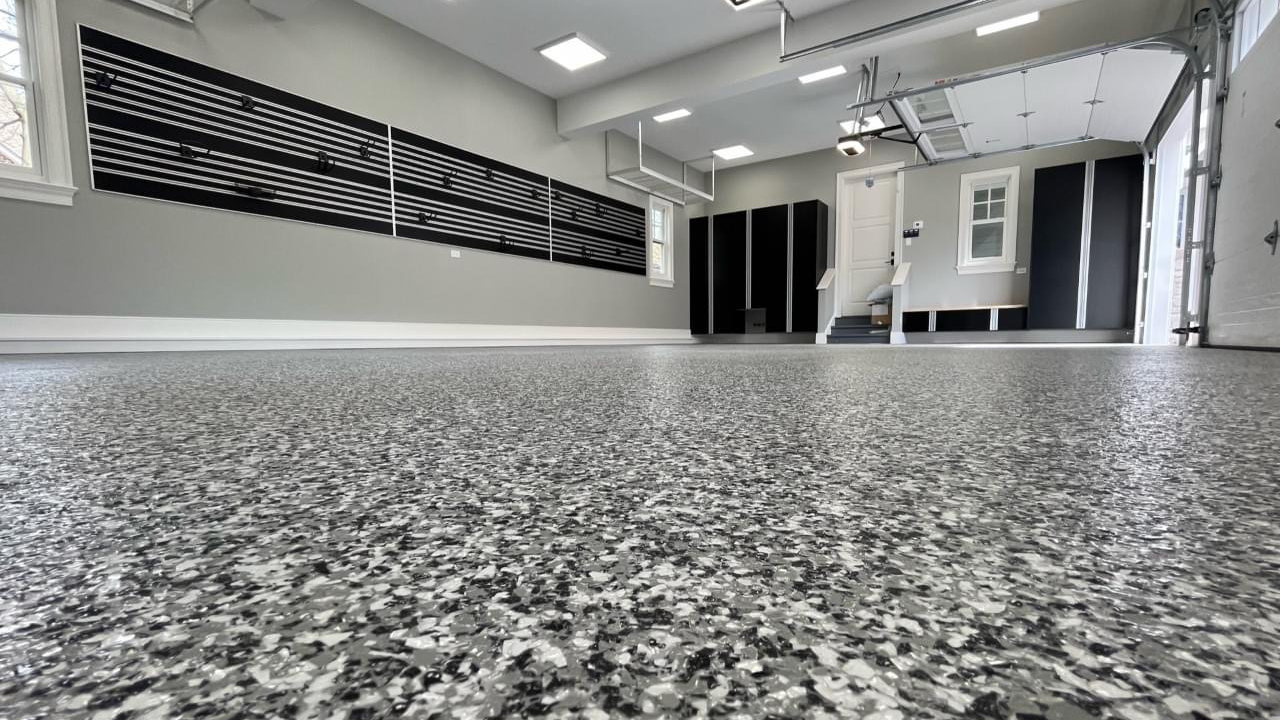
Swisstrax Ribtrax fundamentally sidesteps these pathologies not by trying to bond to the concrete, but by floating above it. It is a “floating floor” system that is mechanically decoupled from the substrate. It does not care if the concrete is cracked, stained, or emitting moisture. It provides a new, consistent, and engineered surface that breathes, drains, and supports.
3. Material Science and Structural Engineering
At the heart of the Swisstrax value proposition is the tile itself. It is not merely a piece of molded plastic; it is a complex structural component designed to handle extreme loads while maintaining flexibility and chemical inertness.
3.1 The Polymer: Virgin Polypropylene Copolymer
The material composition of Ribtrax Pro is the single most critical factor in its performance. The tiles are injection molded from 100% UV-stabilized virgin polypropylene copolymer.2
3.1.1 Virgin vs. Recycled Resin
In the plastics industry, “virgin” denotes resin that has not been previously processed or recycled. While using recycled material is environmentally laudable for packaging or non-structural items, it introduces significant variables in a flooring application. Recycled plastics often contain impurities and have shorter, degraded polymer chains due to the thermal stress of previous melting cycles. This results in material that is more brittle and less consistent in color. Swisstrax’s use of virgin resin ensures that the molecular structure is uniform, maximizing tensile strength and impact resistance. This is why a Swisstrax tile can bend without breaking, whereas a cheaper competitor made of recycled content might snap under the same deflection.
3.1.2 Copolymer vs. Homopolymer
Polypropylene (PP) generally comes in two forms: homopolymer and copolymer.
- Homopolymer: High stiffness but brittle, especially at freezing temperatures.
- Copolymer: Created by polymerizing propylene with ethylene. The ethylene molecules disrupt the crystallinity of the polypropylene, acting as internal impact modifiers. The decision to use a copolymer is why Ribtrax has a temperature tolerance range of -22°F (-30°C) to 248°F (120°C).2 A garage in Minnesota or Canada can experience temperature swings from -20°F in winter to 100°F in summer. A homopolymer tile might shatter if a wrench is dropped on it at -20°F. The Ribtrax copolymer retains enough ductility to absorb the impact energy without catastrophic failure.
3.2 The Injection Molding Process
Swisstrax utilizes a proprietary four-point injection molding process.5 In typical injection molding, molten plastic is injected into the mold from a single gate. For a large, complex lattice structure like a Ribtrax tile, a single gate can lead to “knit lines” where the flow fronts of the plastic meet and cool, creating weak points. By using a four-point injection system, Swisstrax ensures that the mold fills evenly and rapidly, maintaining consistent material density and minimizing internal stresses. This results in a tile that is perfectly flat and dimensionally stable, crucial for maintaining the integrity of a large interlocked floor.
3.3 Structural Metrics: Strength Analysis
The technical data sheets present two key figures that are often misunderstood: Compressive Strength and Rollover Weight.
- Compressive Strength: 3,120 PSI.2
- This figure refers to the pressure required to crush the solid material of the tile. While 3,120 PSI is lower than high-strength concrete (often 4,000+ PSI), it is more than sufficient for distributed loads. The channel structure underneath the tile acts as a series of miniature columns, transferring the load to the concrete.
- Rollover Weight: Up to 70,000 lbs.6
- This is the functional metric for a garage. It means the floor can support the rolling load of a semi-truck, a fire engine, or a loaded forklift without the ribs collapsing. The dynamic nature of rolling loads puts shear stress on the ribs, and the tile’s geometry is optimized to resist this lateral deformation.
Table 1: Technical Specifications Matrix
| Metric | Specification | Engineering Implication |
| Material | UV Stabilized Virgin Polypropylene Copolymer | High impact resistance, color consistency, cold weather ductility. |
| Tile Size | 15.75″ x 15.75″ (40cm x 40cm) | Faster installation, fewer seams, “European” aesthetic. |
| Thickness | 0.75″ (19mm) | Substantial drainage clearance, high load distribution. |
| Weight | 1.47 lbs (0.67 kg) per tile | heavy enough to stay in place, light enough for easy handling. |
| Perforation Width | 0.13″ (3.2mm) | Balances drainage with preventing small tools from falling through. |
| Friction Coefficient | Non-slip when wet | Safety in wash bays and snowy climates. |
| Fire Rating | HB (Horizontal Burn) | Slow burn rate; will not flash-ignite from sparks. |
| Chemical Resistance | Excellent (Hydrocarbons, Acids, Alkalis) | Impervious to common automotive fluids. |
4. The Philosophy of the Open Profile: Hygiene and Drainage
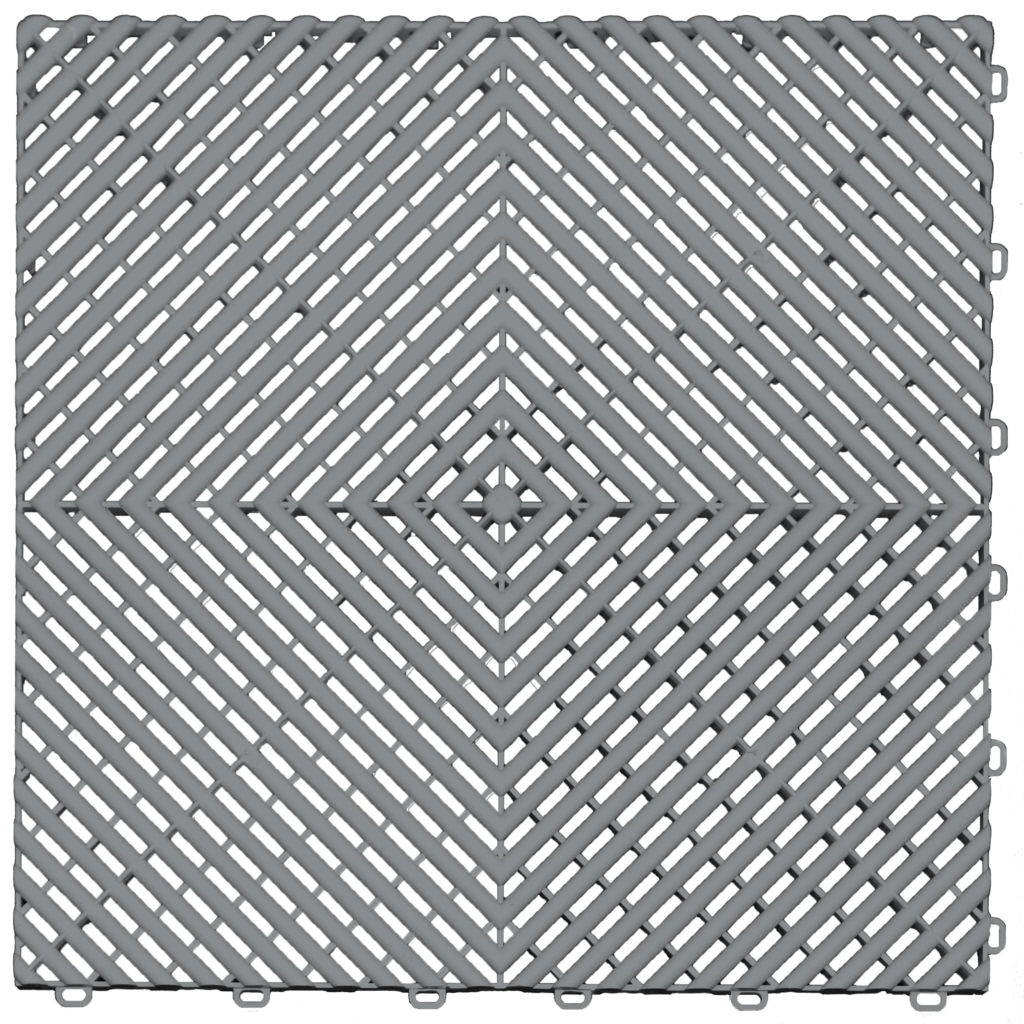
The most visually distinct feature of the Ribtrax line is its “open profile”—a grid of ribs with voids in between. This design is not merely aesthetic; it is a functional response to the problem of dirt and moisture.
4.1 The “Visual Cleanliness” Paradox
In a garage with a solid floor (epoxy or solid tile), dirt has nowhere to go. Every grain of sand, every dead leaf, and every droplet of water sits on the surface, visible and easily tracked into the house or vehicle. To keep a solid floor looking clean, one must sweep constantly.
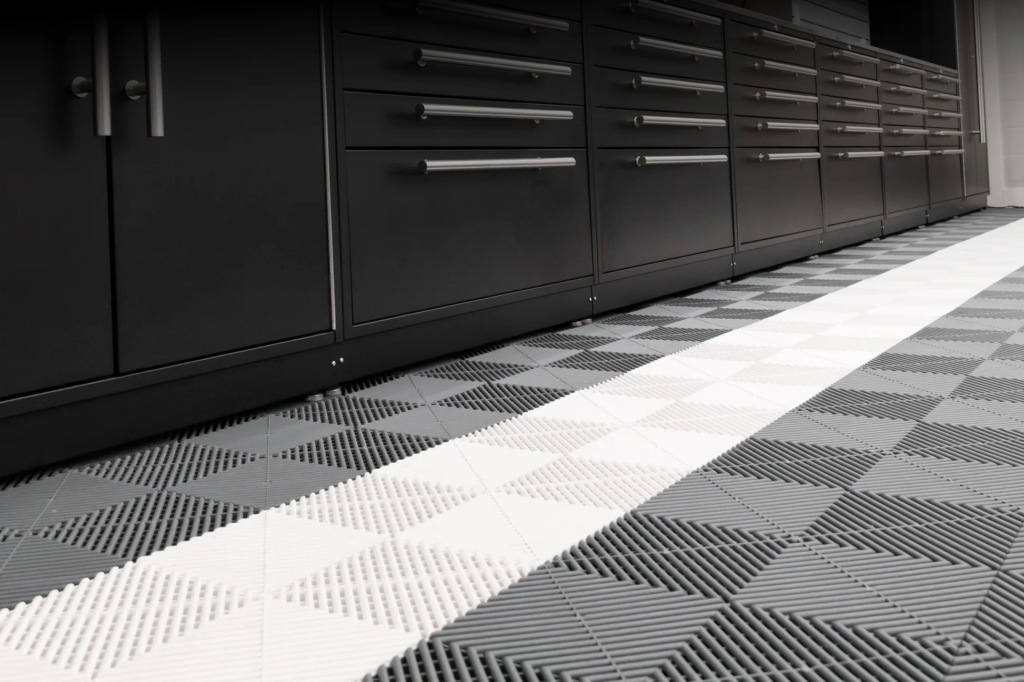
Ribtrax operates on a different principle: Vertical Displacement. The 0.13-inch gaps between the ribs allow debris to fall through the surface and settle on the concrete 0.75 inches below.2
- The Filter Effect: The tile acts as a grate. The surface you walk on remains relatively clean because the dirt is physically separated from your shoes. This is analogous to the “grit guard” used in car washing buckets.8 The dirt is trapped below, preventing it from being ground into the surface or tracked elsewhere.
- Visual Persistence: Because the eye focuses on the top surface of the ribs and the channels below are in shadow, the floor looks clean even when there is a significant amount of debris underneath. For commercial detailing shops or showrooms, this ensures a professional appearance 100% of the time, regardless of the weather outside.
4.2 Fluid Dynamics and Drainage
The underside of the Ribtrax tile features a complex network of channels.8 These channels are designed to allow water to flow freely under the tile.
- Wet Environments: In snowy climates, a car pulls in laden with snow and slush. On a flat floor, this melts into a puddle that surrounds the car, creating a slip hazard and increasing humidity. With Ribtrax, the meltwater drops through the tile. The car is parked on a dry surface, and the water flows underneath toward the garage door or floor drain.
- Evaporation: The airflow through the open grid promotes evaporation of the moisture trapped underneath, preventing the “swampy” smell often associated with rubber mats that trap water against concrete.
5. Comparative Market Analysis
To fully evaluate Swisstrax, it must be benchmarked against its primary competition. The market is bifurcated into coatings (Epoxy) and other modular tiles (primarily RaceDeck).
5.1 Swisstrax vs. The Epoxy Standard
We have established the pathology of coating failures, but what about the cost and lifestyle comparison?
Table 2: Swisstrax Ribtrax vs. Professional Epoxy
| Feature | Swisstrax Ribtrax Pro | Professional Epoxy Coating |
| Installation Time | 4-6 Hours (DIY possible) | 3-5 Days (Professional required) |
| Cure Time | Immediate use | 24-72 hours |
| Surface Prep | Minimal (Sweep/Vacuum) | Extensive (Grinding/Shot Blasting) |
| Moisture Tolerance | 100% (Breathable) | Low (Prone to hydrostatic failure) |
| Repairability | Instant (Swap single tile) | Difficult (Sand and recoat section) |
| Portability | 100% (Take it when you move) | 0% (Sunk cost) |
| Initial Cost | ~$4.00 – $5.00 / sq ft | $6.00 – $10.00 / sq ft (Pro install) |
| Warranty | Limited Lifetime | Varies (1-10 years typically) |
The “portability” factor is a massive financial advantage for Swisstrax.9 An investment in epoxy is an improvement to the real estate that may or may not be recouped at sale. An investment in Swisstrax is an asset acquisition; the floor can be uninstalled and moved to a new home, amortizing the cost over decades of ownership.
5.2 Swisstrax vs. RaceDeck: The Battle of the Tiles
RaceDeck is the other giant in the US modular flooring market. Their “Free-Flow” tile is the direct competitor to Ribtrax. While they share a similar concept, the engineering execution differs significantly.
5.2.1 The Locking Mechanism
- RaceDeck (Snap-Lock): Uses a male/female tab system that snaps vertically. While secure, the friction fit can be extremely tight. Disassembling the floor often requires starting from an edge and “unzipping” large sections.
- Swisstrax (Loop-and-Peg): Swisstrax utilizes a patented loop-and-peg system. This design is not just about holding tiles together; it is designed for serviceability. A single Swisstrax tile can be removed from the center of the floor without disturbing the surrounding tiles.11 Using a simple hook tool or flathead screwdriver, the user lifts the corner, disengages the pegs, and pulls the tile out. This is a critical advantage for cleaning up specific spills or accessing a floor drain.
5.2.2 Size and Seams
- Swisstrax: 15.75″ (40cm).
- RaceDeck: 12.00″. The larger Swisstrax tile results in ~43% fewer seams per square foot. Furthermore, the design of the Swisstrax rib pattern is engineered to camouflage the seam. When installed, a Swisstrax floor appears as a continuous, seamless field. RaceDeck tiles often have a visible “grid” appearance where the tiles meet, breaking the visual immersion.11
5.2.3 Weight and Feel
Swisstrax tiles are generally heavier (23.5 oz) and thicker (0.75″) compared to standard competitors. This mass, combined with the rubber-like quality of the copolymer, gives the floor a more substantial, “dead” sound when walked on. Lighter, cheaper tiles often have a hollow, “plastic-y” click-clack sound that detracts from the premium feel.
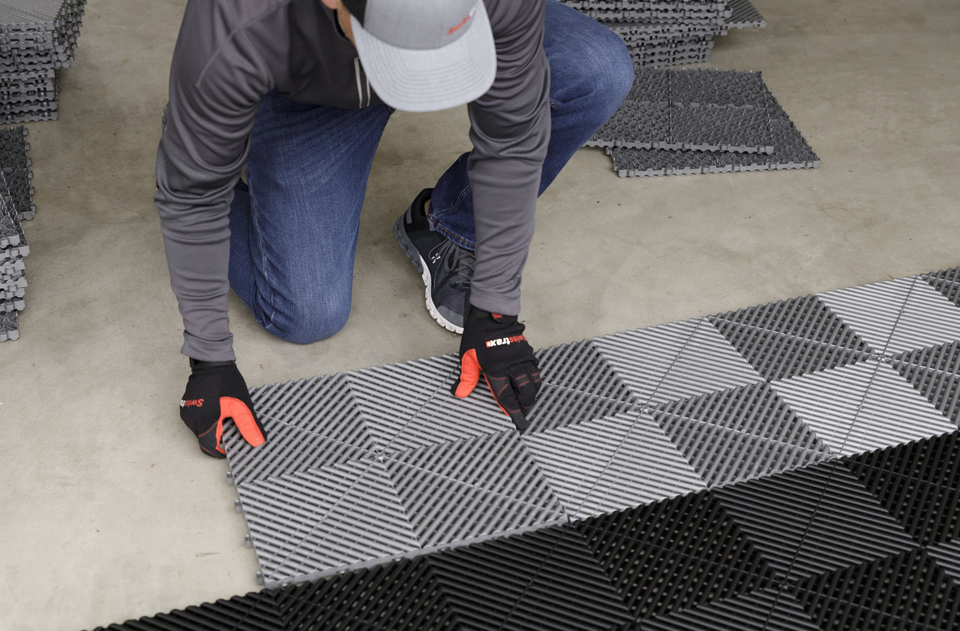
6. Installation: A Technical Narrative
Installation is often marketed as “easy DIY,” but for the perfectionist, it is a precision operation. The following is a detailed walkthrough of the installation process, incorporating best practices for a flawless finish.
6.1 Pre-Installation Preparation
While the floor covers imperfections, the substrate must be stable.
- Debris Removal: The floor must be swept and vacuumed. Any sharp stones left under the tile could point-load the plastic from underneath.
- Leveling: While the tiles bridge small cracks, heaving deviations of more than 0.25 inches should be ground down or filled to prevent the tiles from rocking or creating a trip hazard.
- Acclimatization: It is best practice to let the tiles sit in the garage for 24 hours to acclimatize to the ambient temperature and humidity, ensuring consistent expansion during install.
6.2 Layout Strategy: The “Front-to-Back” Method
Symmetry is the key to a professional look.
- The Critical Edge: The most visible part of the floor is the row of tiles at the garage door. This row should consist of full, uncut tiles for maximum visual integrity.
- Centerline: Measure the width of the garage door opening to find the exact center. Mark this on the floor.
- The First Tile: Installation typically starts at the front left or front right corner, but for a centered design, one might lay the first row dry to ensure the cuts at the side walls are equal.
- Directionality: Swisstrax tiles have a specific orientation (Loop sides and Peg sides). It is crucial to maintain this orientation. Typically, you install with the “Loops” facing the direction you are moving, pressing the “Pegs” of the new tile down into them.13
6.3 The Cutting Phase
The field installation is rapid—the “snap” of the tiles is satisfying and fast. The complexity lies in the perimeter.
- Tools: A circular saw or jigsaw is standard. However, for the cleanest cuts, a table saw with a fine-tooth blade (60-80 tooth laminate blade) is recommended. The high tooth count prevents the plastic from chipping or shattering.
- Thermal Expansion Gap: This is the most critical technical detail. Polypropylene has a high coefficient of thermal expansion. In a non-climate-controlled garage, the floor can grow and shrink significantly. You MUSTleave a gap of 0.25″ to 0.50″ between the tiles and any fixed vertical surface (walls, pillars, workbench legs).13
- Consequence of Failure: If you fit the tiles tight to the wall in winter (contracted state), the floor will expand in summer, hit the wall, and buckle upwards in the center of the garage (tenting).
- Obstacle Integration: For garage door tracks or pipe bollards, a jigsaw is used to scribe the shape. A cardboard template is often useful to get the curve right before cutting the expensive tile.
6.4 The Transition Edges
The installation is capped off with the “looped edges”.7 These are 15.75″ ramp pieces that snap onto the front row. They provide a smooth rolling transition for vehicles and protect the raw edge of the tile from impact damage. Swisstrax offers these in matching colors, allowing for a seamless visual flow or a contrasting safety yellow.
7. The Aesthetic Ecosystem: Design and Customization
The modularity of Swisstrax allows for a level of customization that epoxy cannot match without immense labor.
7.1 Visual Texture and Light
The “3D” nature of the open profile creates a matte, textured appearance. This is optically superior for a working garage compared to high-gloss epoxy. Glossy floors act as mirrors, highlighting every scratch, swirl mark, and spec of dust. The ribbed texture of Swisstrax absorbs light and breaks up reflections. This “visual noise” camouflage is why the floor can look clean even when it isn’t.
7.2 Color Theory and Patterns
With ~18 standard colors 9, the design possibilities are infinite, but three archetypes dominate:
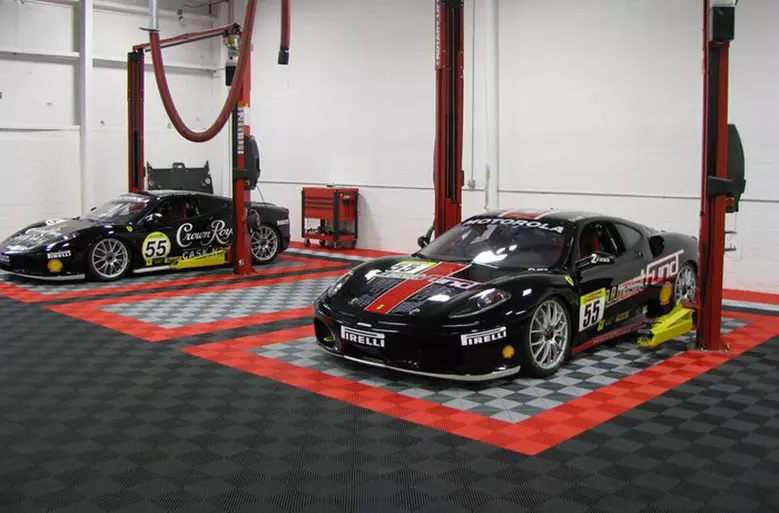
- The Checkerboard: The classic “diner” or “racing” look. High contrast (Black/White or Red/Black). It is energetic but can make a small space feel cluttered.
- The “Area Rug”: A solid field color (e.g., Slate Grey) with a contrasting border (e.g., Pearl Silver). This defines the parking space and creates a sophisticated, architectural look.
- Zoning: Using color to define function. Red tiles around the workbench to denote a “danger/work zone,” or grey tiles for the walkway.
7.3 The Swisstrax Ecosystem Compatibility
A key advantage is the ability to mix different tile types within the same 15.75″ Pro ecosystem.12
- Ribtrax Pro: The standard open tile, used for the main floor and parking pads.
- Ribtrax Smooth Pro: An open profile tile but with a flat top surface (no rounded ribs). This is easier on the knees and smoother for rolling casters, often used in workshop areas.15
- Vinyltrax Pro: A solid tile with a vinyl inlay (wood grain, carbon fiber, polished concrete look). This can be used to create a “lounge” area or a dance floor within the garage.
- Note: The “12-Series” tiles (Diamondtrax 12) are not compatible with the Pro line. Mixing them requires complex custom cutting and is generally not recommended.
8. Operational Reality: Living with the Floor
Beyond the specs and the look, how does the floor perform in daily life?
8.1 Maintenance and Cleaning Protocols
The “dirt trap” concern is valid but manageable.
- Routine Cleaning: A shop vac is the primary tool. The suction pulls dust up through the vents. A leaf blower can also be used to blow light debris out the garage door.
- Washing: For muddy messes, the floor can be mopped. The mop glides over the ribs, cleaning the top surface.
- Deep Cleaning: Once or twice a year, a pressure washer can be used to blast the concrete underneath. The channels allow the water and sediment to flow out.
- The “Reset”: Because of the easy removal capability, every 2-3 years, an owner can unzip large sections, pull them onto the driveway, and thoroughly scrub the concrete substrate. This resets the garage to clinical cleanliness.8
8.2 Ergonomics and Acoustics
- Anti-Fatigue: While not a soft foam mat, the sprung nature of the tile (due to the arched ribs and plastic flex) provides noticeable relief compared to concrete. Standing for 4 hours at a workbench is significantly less fatiguing on the lower back and joints.
- Thermal Comfort: The air gap acts as an insulator. The floor assumes the ambient air temperature rather than the ground temperature. In winter, this makes a massive difference for mechanics lying under a car.
- Noise: The floor dampens the high-frequency “ring” of a dropped wrench. Walking on it creates a distinct “clack” sound, which some find industrial and others find reassuringly solid. Using a rubber underlayment (like recycled rubber rolls) can mute this sound and provide a more solid “thud”.18
8.3 Rolling Resistance
This is the primary functional drawback. The gaps in the ribs can catch the small wheels of creeper seats or lightweight trolley jacks.
- Mitigation: Upgrading to larger diameter wheels (3″+) on creepers solves this. For heavy toolboxes, the initial force to start them rolling is higher than on smooth concrete, but they will roll.
8.4 The Jack Stand Protocol (Critical Safety)
Standard jack stands have sharp feet that concentrate thousands of pounds of force into tiny surface areas. On Ribtrax, these feet can sink between the ribs or crush the plastic structure, leading to instability or permanent damage.
- The Rule: ALWAYS use a load distribution plate. A simple 12″x12″ square of 0.5″ plywood or a metal plate placed under the jack stand distributes the load across the tile’s structure, making it perfectly safe.20 Floor jacks with wide rollers generally work fine without protection, but caution is advised.
9. Durability and Testing Logic
To validate the “Limited Lifetime Warranty” claims, we analyze the testing logic applied to these tiles.
9.1 The Rolling Load Test
The “70,000 lbs rollover weight” is tested using a dynamic load cell. A weighted wheel is rolled back and forth across the tile. The failure point is defined as the weight at which the ribs show permanent plastic deformation (flattening). 70,000 lbs is effectively infinite for a residential setting—a Ford F-350 weighs ~8,000 lbs. You could park a fire truck on these tiles without structural failure.6
9.2 Chemical Resistance Testing
Polypropylene is legendary for its chemical resistance.
- Test: A pool of used motor oil, brake fluid (DOT 3), and gasoline is left on the tile for 24 hours.
- Result: The fluids do not bond to the plastic. They can be wiped off with a rag. There is no staining, no softening, and no discoloration. This is in stark contrast to epoxy, which can stain if oil is left too long, or asphalt tiles which dissolve in gasoline.4
9.3 Impact Testing
The copolymer’s flexibility is tested by dropping heavy objects (hammers, brake rotors) from height. The tile absorbs the energy through elastic deformation. In extreme cold (-20°F), the material becomes stiffer, but the virgin resin prevents it from becoming “glass-like” and shattering.2
10. Financial Analysis: The Total Cost of Ownership
Swisstrax is a premium product with a premium price tag. Is it worth it?
10.1 The Price Breakdown
- Ribtrax Pro MSRP: Approximately $4.99 per square foot.2
- Edges: ~$3.00 – $5.00 per linear foot.
- Example Calculation (20′ x 20′ Garage – 400 sq ft):
- Tiles: 400 sq ft * $4.99 = $1,996.
- Edges: 20 ft * $4.00 = $80.
- Total Material Cost: ~$2,076.
10.2 Discounts and The Referral “Hack”
Smart buyers never pay full MSRP.
- Direct Sales: Swisstrax.com often runs sales (15-25% off) during major holidays (Memorial Day, Black Friday).
- Affiliate Codes: Influencers and partners (e.g., Obsessed Garage, automotive YouTubers) often have codes for free shipping or percentage discounts (e.g., “RADGARAGE” for $0.25/sq ft off in Canada).23
- The Referral Program: This is a hidden gem. Swisstrax offers a $100 Visa Gift Card for referrals. If you refer a friend who buys at least 200 sq ft (half a garage), you get $100. This is a powerful incentive for car clubs or groups of friends building garages together.9
10.3 The ROI of Portability
The most significant financial argument for Swisstrax over epoxy is equity retention.
- Epoxy: Sunk cost. You cannot take it with you. It adds marginal value to the home sale.
- Swisstrax: It is personal property. When you move, you spend 2 hours unzipping the floor, pack it in boxes, and take it to your new house. If the new garage is a different shape, you simply buy a few more tiles or trim the existing ones. Over a lifetime of moving 3-4 times, the cost per year of Swisstrax drops drastically compared to re-epoxying every new garage.10
11. FAQ: The Enthusiast’s Doubts
Q: Will the tiles stain from tire dressing?
A: Silicone-based tire dressings can make the tiles slippery, but they generally do not stain the pigmented polypropylene. However, care should be taken to wipe up excess dressing to prevent slip hazards.
Q: Can I use a creeping stool? A: Yes, but it will be bumpy. Upgrading to “rollerblade” style soft rubber casters (3-inch diameter) is highly recommended for a smoother ride over the ribs.8
Q: What happens if I turn my wheels while the car is stationary?
A: This creates significant torque on the floor. On cheap tiles, this can snap the locks. On Swisstrax, the weight of the car effectively pins the tile to the concrete, and the locks are strong enough to resist separation. However, in extreme cases (heavy truck, sticky tires, hot day), some minor shifting can occur, which is easily kicked back into place.
Q: Is it fireproof? A: No. It is rated HB (Horizontal Burn). It will melt if exposed to a direct torch or welding slag. Welding blankets are mandatory if you are doing hot work over the floor.2
12. Conclusion: The Verdict
Swisstrax Ribtrax Pro is not merely a floor covering; it is an engineered infrastructure upgrade for the garage. It solves the fundamental problems of concrete—aesthetics, moisture, and dust—through a clever application of material science and geometry.
While the “open profile” design requires a shift in mindset regarding dirt management (accepting that the dirt is hidden below rather than swept away daily), the benefits in visual cleanliness and drainage are undeniable. For the detailing enthusiast, the ability to wash a car indoors without standing in a puddle is transformative. For the general homeowner, the instant elevation of the garage’s aesthetic from “storage unit” to “showroom” adds tangible quality-of-life value.
The comparison with epoxy is ultimately a choice between a permanent, high-maintenance chemical finish and a flexible, durable mechanical system. For those who value longevity, repairability, and the ability to control their environment, Swisstrax is the superior choice. It is an investment that survives the harsh reality of automotive passion—heavy jacks, spilled oil, and dropped tools—and asks only for a quick rinse in return.
Final Recommendation:
For the serious garage enthusiast, the Swisstrax Ribtrax Pro is a Buy. The combination of the virgin copolymer durability, the serviceable loop-and-peg system, and the stunning visual impact justifies the premium price. It is the tuxedo for your garage: durable, stylish, and always ready for the showroom.