
Some links below are affiliate links. If you buy through one, we earn a commission at no extra cost to you. It never changes a verdict — here is how that works.
If your garage has a single bare bulb hanging from the ceiling, you’re working in the dark. Literally. One light source creates shadows everywhere — behind the car, under the workbench, in every corner where you actually need to see.
Good garage lighting is the single most impactful upgrade you can make to your workspace. It’s also one of the cheapest. A full LED lighting retrofit for a two-car garage costs $100-$300 and takes an afternoon. The difference is transformative.
Here’s how to plan and execute a garage lighting upgrade that eliminates shadows, provides even coverage, and makes your garage feel like a professional workspace.
How Much Light You Actually Need
The standard recommendation for garage workspace lighting is 50 lumens per square foot. A standard two-car garage (20×20 feet = 400 square feet) needs roughly 20,000 lumens of total output.
For context, a traditional 60-watt incandescent bulb produces about 800 lumens. A single bulb in a 400 square foot garage gives you 2 lumens per square foot. You need 25x more light than what a single bulb provides. No wonder you can’t see what you’re doing.
If your garage doubles as a workshop, bump that target to 75-100 lumens per square foot. Detail work — wiring, small parts, paint finishing — demands more light than parking cars and storing boxes.
The LED Advantage
LED shop lights have completely replaced fluorescent tubes for garage use, and for good reason. They’re brighter, more energy-efficient, longer-lasting, and they work in cold temperatures without the warmup delay that fluorescent tubes require.
A 4-foot LED shop light producing 4,000-5,000 lumens costs $15-$30 and lasts 50,000+ hours. At 3 hours of daily use, that’s over 45 years of operation. You’ll sell the house before the lights burn out.
The wattage-to-lumen ratio matters. Look for LED fixtures producing at least 130 lumens per watt. This means a 40-watt LED fixture produces 5,200+ lumens — more light than a 150-watt incandescent bulb at a fraction of the energy cost.
Color temperature affects how your garage feels. For most garages, aim for the 4000K–5000K range. 5000K (daylight) is the usual garage target and the better pick for task and detail work. If you want a warmer, less clinical feel, 4000K (neutral white) works well too. For paint and other color-sensitive work, also look for a high CRI rating when the listing states one. For a full lumen plan and specific fixture picks, see our main garage lighting guide.
The Layout
This is where most people go wrong. They buy bright lights but mount them all in a line down the center of the ceiling. This creates bright spots directly under the fixtures and shadows everywhere else.
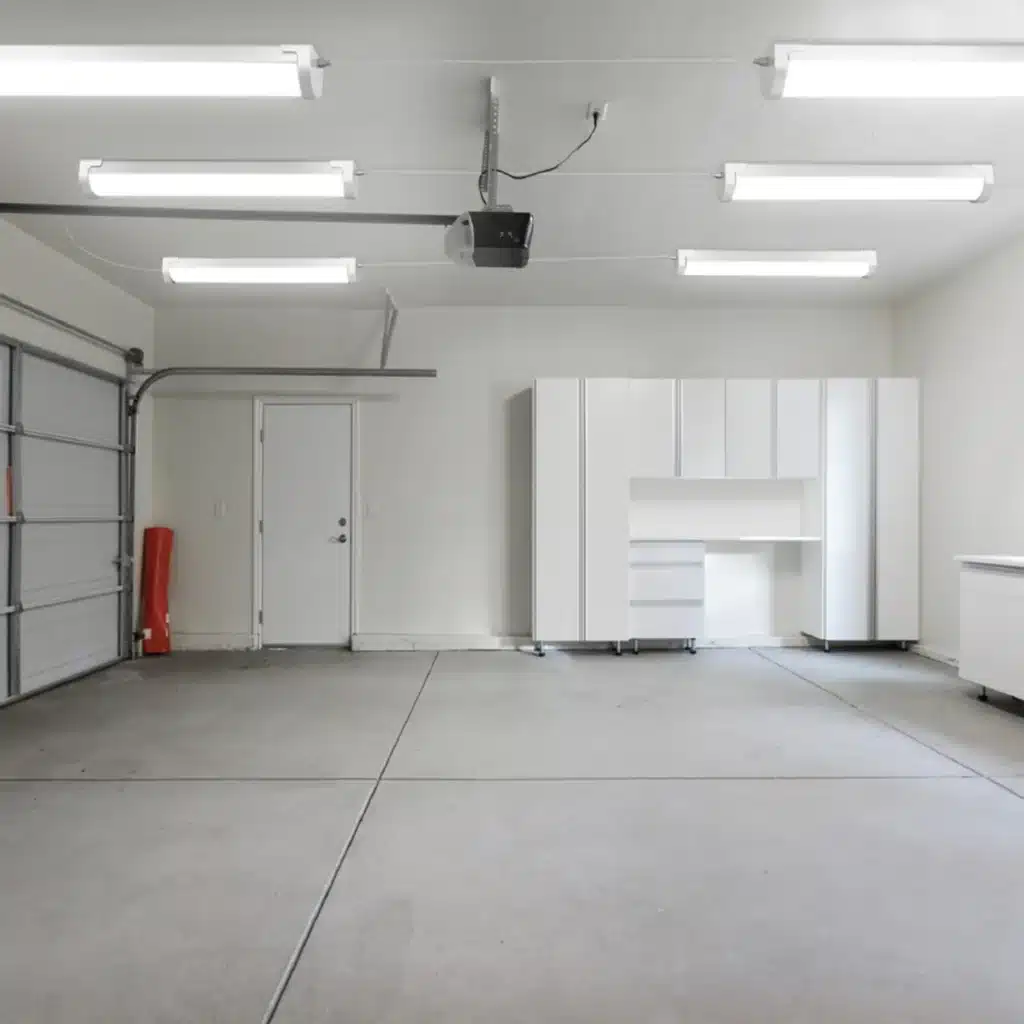
The correct approach is a grid layout. For a two-car garage, aim for 4-6 fixtures arranged in two parallel rows, offset from each other. This creates overlapping light cones that eliminate shadows across the entire floor area.
Mount lights perpendicular to the direction you most often face. If your workbench runs along the back wall, mount the lights so they run front-to-back. This puts light on both sides of whatever you’re working on, rather than casting your own shadow onto the work surface.
If you have a specific work area — workbench, tool wall, or project car — add a dedicated task light above that zone. An additional fixture mounted directly over the workbench provides the extra lumens needed for detail work without over-lighting the rest of the garage.
Installation Options
Hardwired fixtures require basic electrical knowledge and a circuit with capacity. If your garage has existing fluorescent tube housings, LED replacement tubes or retrofit fixtures are the easiest swap — same electrical connection, dramatically better light.
Plug-in LED shop lights are the zero-electrical-skill option. They come with power cords and built-in on/off switches. Hang them from hooks or chains, plug into existing outlets, and you’re done. The only limitation is outlet availability — you may need to add a power strip or extension setup if your garage has limited outlets.
LED light panels that screw into existing bulb sockets are the simplest upgrade of all. Deformable panels with multiple adjustable segments screw into a standard E26 socket and produce 6,000-10,000 lumens per unit. If your garage has ceiling-mounted bulb sockets, this gets you massive lumens with zero installation beyond screwing in a “bulb.”
The Bottom Line
Good lighting changes how you use your garage. Projects that frustrated you under dim, shadowy conditions become easier and more enjoyable when you can actually see what you’re doing. Colors look accurate. Details are visible. You stop leaning over your work to block the light source.
A $200 LED lighting upgrade transforms a dark, underutilized garage into a workspace you actually want to spend time in. It’s the highest-return improvement in the entire garage upgrade stack. Do it first. Everything else you build, organize, and work on in your garage will be better because of it.
Update, September 23, 2026: We updated our color temperature advice to match our main garage lighting guide: 4000K–5000K suits most garages, with 5000K the better choice for task and detail work.
