
Some links below are affiliate links. If you buy through one, we earn a commission at no extra cost to you. It never changes a verdict — here is how that works.
How this guide was built: it compares manufacturer-published specifications and current listings. We have not bench-tested these products, and nothing below claims otherwise.
A portable inflator is one of the cheapest pieces of insurance you can keep in a car, and a decent gauge is cheaper still. The products in this category look alike and quote the same headline number, so the useful questions are different ones: where does the power come from, how long can it run before it has to cool down, and can you trust the reading?
What actually matters
Maximum PSI is a marketing number
Nearly every small inflator advertises 100–150 PSI. A passenger car runs 30–45 PSI; even most light trucks stay under 80. Any inflator here reaches those pressures. What separates them is airflow (litres per minute — how long a top-up takes) and duty cycle (how many minutes it may run before it must rest). Makers publish both less prominently than PSI; look for them on the listing, and expect a compact unit to need a cool-down after roughly 10–15 minutes of continuous running. For that reason none of these is the right tool for seating beads, filling large truck or RV tires from flat, or running air tools — that is a job for a garage air compressor.
12V corded vs cordless
Corded 12V inflators plug into the car’s accessory socket. They never have a flat battery, they generally run longer, and they cost less. The cord has to reach all four wheels — about 10 feet does on most cars — and the engine should be running while you use one. Cordless inflators are easier to carry to a bike, a wheelbarrow or a trailer, but their battery is small: good for top-ups and one or two tires from low, and useless if it has sat discharged in the trunk for a year. If it lives in the car for emergencies, corded is the safer choice; if it lives on a garage shelf and gets used monthly, cordless is more pleasant.
Auto shut-off, and why you still want a gauge
Every inflator here lets you set a target pressure and stops on its own. The built-in sensor reads while air is flowing, so treat it as close rather than exact and confirm with a standalone gauge. Check pressures cold (before driving, or after the car has sat a few hours) and use the figure on the driver’s door-jamb placard, not the maximum printed on the tire sidewall.
The picks at a glance
| Product | Type | Key manufacturer specs | Best for |
|---|---|---|---|
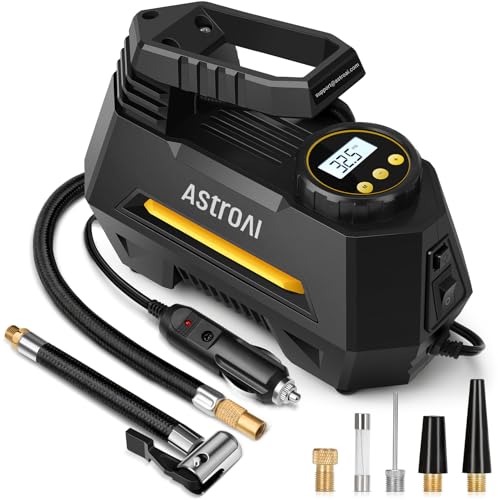
| AstroAI Portable Air Compressor (12V) | Corded 12V inflator | Accessory-socket power, 9.8 ft cord, digital gauge, auto shut-off, LED light | Keeping in the car |
| ROCGORLD R8 | Corded 12V inflator | Accessory-socket power, large dual display (set and current pressure), four units, auto shut-off | Corded alternative with an easier-to-read screen |
| AstroAI L7 | Cordless inflator | Rechargeable battery, dual-value display, LED light, auto shut-off | Garage-shelf top-ups, bikes and balls |
| Airmoto | Cordless inflator | Rechargeable battery, digital gauge, auto shut-off, LED light, multiple valve adapters | Compact cordless with wide availability of spares |
| ETENWOLF T300 | Digital gauge | 3–200 PSI, maker states calibration to ANSI B40.7 Grade 2A, replaceable AAA batteries | The gauge to trust; trucks, RVs and trailers too |
| AstroAI Digital Tire Pressure Gauge | Digital gauge | 0–150 PSI, backlit display, four units, Presta adapter included | Budget glovebox gauge; cyclists |
Corded 12V inflators
AstroAI Portable Air Compressor — the default for the trunk
The long-running AstroAI 12V unit is the template for this category: accessory-socket plug, a 9.8 ft power cord, a backlit digital gauge with a settable target, automatic shut-off and an LED work light. It includes adapters for balls and inflatables. Because it draws from the car, it is ready whenever the car is — which is the point of an emergency tool. Check the AstroAI 12V inflator on Amazon.
ROCGORLD R8 — larger display
Same 12V corded format with a bigger dual-readout screen showing target and live pressure together, in PSI, bar, kPa or kg/cm². The maker claims faster inflation than typical compact units; look for the airflow figure on the current listing rather than relying on the multiple. Check the ROCGORLD R8 on Amazon.
Cordless inflators
AstroAI L7 — cordless for the garage shelf
A handheld rechargeable inflator with a dual-value display, LED light and automatic shut-off. It suits monthly pressure checks at home, bikes, motorcycles and sports gear. Put a recharge reminder on the calendar if it is going to live in a vehicle — lithium cells self-discharge, and heat in a parked car shortens their life. Check the AstroAI L7 on Amazon.
Airmoto — compact cordless
The heavily advertised Airmoto is the same idea in a slightly different shape: rechargeable, digital gauge with preset, auto shut-off, LED light and a set of valve adapters. As with every handheld cordless unit, plan on top-ups and a tire or two from low per charge, not four flats. Check the Airmoto on Amazon.
Tire pressure gauges
ETENWOLF T300 — the one to calibrate everything else against
A 3–200 PSI digital gauge that the maker states is calibrated to ANSI B40.7 Grade 2A, with replaceable AAA batteries rather than coin cells and a high-visibility housing. The range covers cars, light trucks, RVs and trailers. If you own one accurate gauge, you can check what your inflator’s built-in sensor and your car’s TPMS are really telling you. Check the ETENWOLF T300 on Amazon.
AstroAI Digital Tire Pressure Gauge — budget pick
A 0–150 PSI pocket gauge with a backlit screen, four units, a non-slip grip, auto power-off and a Presta adapter for bicycle valves. Inexpensive enough to keep one in each vehicle. Check the AstroAI gauge on Amazon.
Which one to buy
- One inflator that lives in the car: a corded 12V unit — the AstroAI, or the R8 if you want the larger screen.
- Home garage, several vehicles plus bikes: a cordless L7 or Airmoto for convenience, or a real shop compressor if you also want air tools.
- Everyone: a standalone gauge. The T300 if accuracy matters or you run higher-pressure tires; the AstroAI if you just want one in every glovebox.
- Building a roadside kit? Pair the inflator with a jump starter — several combine both. See our jump starter and battery charger guide.
Frequently asked questions
Can a portable inflator fill a completely flat tire?
Usually, if the tire is still seated on the rim and the puncture is slow — but it may take longer than the unit’s duty cycle allows in one run. Let it cool as the manual says and continue. It cannot re-seat a tire that has come off the bead.
How often should I check tire pressure?
Monthly and before long trips, with the tires cold. Pressure drops roughly 1 PSI for every 10°F fall in temperature, which is why TPMS lights appear on the first cold morning of autumn.
Which pressure do I inflate to?
The vehicle maker’s figure on the driver’s door-jamb placard (or in the owner’s manual). The number on the tire sidewall is the tire’s maximum, not the recommendation.
Should I run the engine while using a 12V inflator?
Yes. It keeps voltage up and avoids draining the battery. Check the fuse rating of the accessory socket against the inflator’s stated current draw — higher-output units can exceed a 10A socket.
