
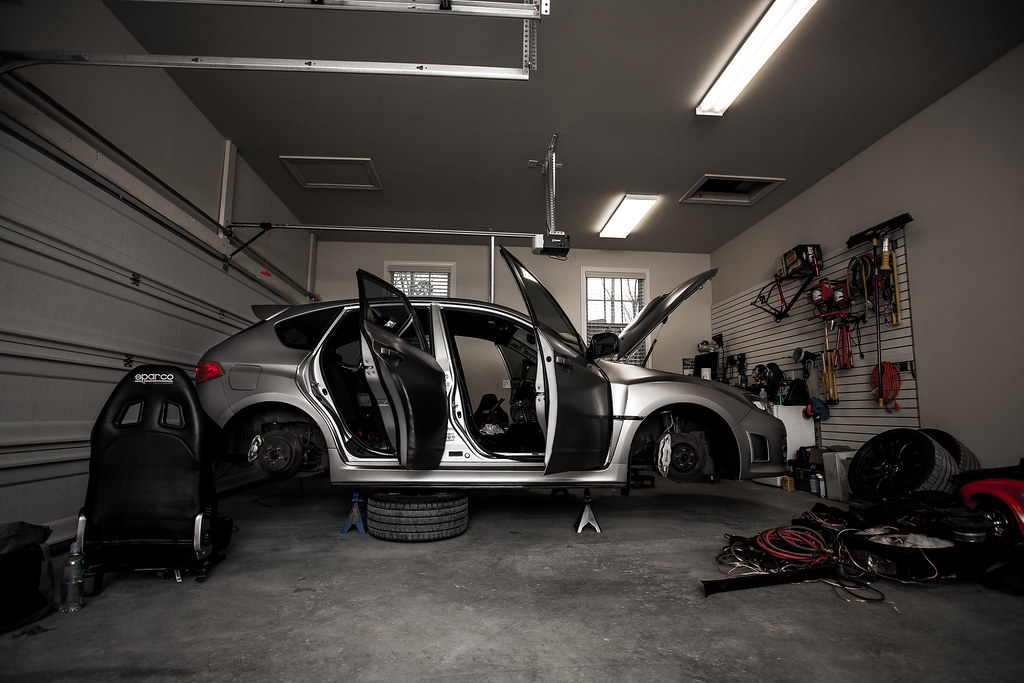
Every year people are killed under cars that were held up by a jack. Not by a broken stand or a collapsing lift: by a jack, used alone, because the job was only going to take a minute. The equipment that prevents it costs less than a tank of fuel. This guide covers how to choose that equipment and how to use it, in that order, with the arithmetic shown.
The one rule
A jack lifts. A stand holds. No part of your body goes under a vehicle that is supported only by a jack.
A hydraulic jack holds its load on a seal and a release valve. Seals weep, valves get bumped, and a jack that has held for ten years can let go in a second with no warning. A jack stand is a steel post with a mechanical lock. It cannot leak down. Everything else in this article is detail.
What the tonnage on a jack means
A floor jack never lifts the whole car. It lifts one end or one corner, while the wheels still on the ground carry the rest. On a typical front-engined vehicle about 55 to 60 percent of the weight sits on the front axle, so lifting the front by the centre crossmember puts a little over half the vehicle’s weight on the jack. Lifting one corner puts about a quarter to a third on it.
That gives a simple sizing rule: the jack’s rated capacity should be at least three-quarters of the vehicle’s gross weight. It sounds generous, and it is meant to be. The margin covers a loaded vehicle, an uneven surface and the fact that a jack working near its limit is slow, heavy to pump and wears faster.
| Vehicle | Typical curb weight | Minimum jack | Sensible jack |
|---|---|---|---|
| Compact or midsize sedan | 2,900–3,600 lb | 1.5 ton | 2 ton |
| Crossover, minivan, midsize SUV | 3,600–4,800 lb | 2 ton | 3 ton |
| Half-ton pickup, full-size SUV | 4,800–6,000 lb | 3 ton | 3 ton, long reach |
| Electric crossover or sedan | 4,000–5,300 lb | 2 ton | 3 ton, low profile |
| Electric pickup, heavy-duty truck | 6,500–9,000+ lb | 3.5 ton | 4 ton or more |
A ton here is 2,000 lb. For nearly every household the answer is a 3-ton jack. It costs little more than a 2-ton, handles the family SUV and the truck that replaces it, and works well inside its limits on everything smaller. The one good reason to buy smaller is weight, discussed below.
Electric vehicles deserve a note. They are heavy for their size, since a battery pack adds 1,000 lb or more, and they are low. A car that looks like a midsize sedan can weigh what a half-ton pickup did twenty years ago.
The numbers that matter more than tonnage
Most people who are unhappy with their jack bought enough capacity and the wrong height range.
Minimum saddle height
This is how low the lifting pad sits when the jack is fully down, and it decides whether the jack goes under your car at all. Standard floor jacks start at 5 to 5.5 inches. Low-profile jacks start at 3 to 3.75 inches, and a few racing-style jacks go under 3. Measure from the ground to your car’s front jacking point, then take off another inch for a flat tyre, because that is when you will most want the jack to fit.
Maximum lift height
To get a wheel off the ground the jack must take up the suspension’s droop before the tyre lifts, and then raise the car far enough to set a stand under it. Cars need about 18 to 20 inches of maximum height. Trucks and body-on-frame SUVs need 21 to 24, and lifted trucks more. A compact 2-ton “trolley” jack that tops out at 13 or 14 inches will lift a sedan’s wheel clear and do nothing useful under a pickup’s frame.
Reach
The central jacking point on many cars is 2 to 3 feet behind the bumper. A short jack cannot get there without its handle fouling the bodywork. Long-frame jacks exist for this. They are also much heavier.
Weight of the jack itself
A 3-ton steel floor jack weighs 70 to 100 lb. A 3-ton aluminium one weighs 55 to 60, and a 1.5-ton aluminium racing jack about 30 to 35. If the jack lives in one bay and rolls three feet, buy steel: it is cheaper and lasts. If it goes in a truck bed, to a track day, or up a step, aluminium is worth the premium. Hybrid jacks with aluminium side plates and a steel lift arm split the difference.
Pump speed
Dual-piston (“rapid pump”) jacks reach the jacking point in three to five strokes instead of ten to fifteen, then lift at the normal rate. It is a convenience, not a safety feature, but it is one you notice every time.
Bottle jacks and scissor jacks
A bottle jack packs a lot of capacity into a small, cheap package, and 6-, 12- and 20-ton bottles are common. It has a high minimum height (usually 7 to 9 inches), a small saddle and a narrow base, so it suits trucks with frame rails and is a poor fit for cars. It is the right tool for a heavy pickup’s emergency kit and the wrong one for brake jobs on a hatchback.
The scissor jack in the boot exists to change a wheel at the roadside, on the car’s own marked points, with nobody underneath. It is unstable under any sideways force. It has no other use in a garage.
Jack stands: read the rating correctly
In the US, stands are sold and rated as a pair. Under the ASME PASE standard that governs this equipment, a “3-ton” set of stands supports 3 tons between the two of them, which is 1.5 tons, or 3,000 lb, per stand. People who assume 3 tons each are wrong by a factor of two.
The standard also requires each stand to survive a proof test at twice its rated load, so there is real margin built in. Use it as margin, not as capacity. Sizing stands is straightforward:
- 3-ton pair: cars, crossovers and most midsize SUVs. One end of a 4,500 lb vehicle puts roughly 2,500 lb on the pair.
- 6-ton pair: half-ton and heavier trucks, full-size SUVs, heavy EVs. The extra capacity is welcome, but the real reason is height and footprint: 6-ton stands are taller, typically adjusting from about 15 to 23 inches against 11 to 17 for a 3-ton pair, and their bases are wider.
- 12-ton pair: heavy-duty trucks and RVs.
Buy four. Two stands put one end of the car in the air, which covers brakes and oil changes. Anything involving the exhaust, driveshaft, fuel tank or transmission goes better and more safely with the car level on four.
Ratchet or pin
Ratcheting stands have a toothed centre post held by a spring-loaded pawl. They adjust quickly in small steps, and they are what most garages own. Their weak point is the pawl: if it is not fully seated in a tooth, or the teeth are badly cast, the post can drop.
Pin-type stands pass a steel pin through holes in the post and the body. Adjustment is coarser, an inch or more per hole, but there is nothing to slip. The load is carried by a pin in double shear.
Double-locking stands are ratchet stands with a secondary pin or locking bar through the post. They give the fine adjustment of one and the certainty of the other, and they have become the default recommendation for good reason.
The 2020 recall, and why it changed the advice
In 2020 Harbor Freight recalled more than 1.7 million Pittsburgh Automotive 3-ton and 6-ton ratcheting stands (items 56371, 61196 and 61197) in co-operation with NHTSA. Worn tooling at the factory had produced posts on which the pawl could disengage under load if the weight shifted. Some of the stands supplied as replacements were then recalled in turn for a weld defect. If you own Pittsburgh stands bought between about 2012 and 2020, look up the item number on NHTSA’s site before you use them again.
The wider lesson is not about one retailer. A single-pawl ratchet is one small piece of cast metal away from failure, and it was the most popular stand design in the country. Stands with a second, independent lock cost a few dollars more.
Where a vehicle can be lifted and supported
The owner’s manual shows the approved points, and for a modern unibody car those are the only ones to trust. The usual candidates:
- Pinch welds. The seam that runs along the bottom of the sill, with a reinforced section behind each front wheel and ahead of each rear wheel, often marked with a notch or an arrow. They are strong vertically and easy to fold sideways. A slotted rubber pad or a pinch-weld adapter on the jack saddle or stand keeps the seam straight and the paint intact.
- Front subframe or crossmember. On many cars a central point lifts the whole front end. It must be the structural crossmember. The radiator support, the oil pan, the transmission pan and the plastic undertray are not.
- Rear differential or axle tube. On solid-axle trucks, the differential housing is a normal central lift point and the axle tubes are normal places for stands. On independent rear suspension, do not lift by the differential unless the manual says so.
- Frame rails. On body-on-frame trucks, anywhere on the flat of the rail.
- Dedicated lift pads. Many EVs and some European cars have four specific sockets or pads and nothing else. On an EV the battery pack fills the floor between the axles and its casing is not a lifting surface; a jack in the wrong place can puncture it. Adapter pucks that locate in the sockets cost very little.
Never support a car by suspension arms, tie rods, the exhaust, the floor pan or the rocker panel cover. If a point looks convenient and is not in the manual, it is probably sheet metal.
A practical problem follows from this: on many cars the best jacking point and the best stand point are the same spot. The usual answer is to lift by the central point and set stands under the side points, or to lift at the side point with the jack placed slightly inboard on the reinforced seam and the stand beside it. Work it out for your car once, in daylight, before you need to.
The surface
Level concrete is the only good surface. A slope that looks trivial becomes a sideways load once the wheels are off the ground, and a rolling floor jack will try to follow it.
Asphalt is soft, more so in summer. Stand feet sink into it, unevenly. If you have to work on it, put each stand on a piece of three-quarter-inch plywood about a foot square, or a steel plate. The same goes for pavers. Do not jack on gravel, grass or dirt except to change a wheel in an emergency, and then with a board under the jack and nobody under the car.
The jack needs to roll. As the arm rises, the saddle moves in an arc, and the jack creeps forward on its wheels to stay under the point. On a rough or soft surface it cannot, and it drags the car sideways instead. This is why a board under a floor jack should be large enough for the jack to travel on.
The routine
- Park on level concrete. Transmission in park or in gear, parking brake on. If you are lifting the rear of a car whose parking brake works on the rear wheels, the chocks are doing all the work, so place them properly.
- Chock both sides of a wheel that is staying on the ground, at the opposite end from the one you are lifting.
- Crack the wheel nuts loose half a turn while the tyre is on the ground, if the wheels are coming off.
- Position the jack squarely under the lift point, saddle centred, handle clear of the bumper. Pump until it touches, then stop and look underneath to check what it is touching.
- Lift smoothly to a little above the height the stands will sit at. Keep your feet and hands out from under the car while it is on the jack.
- Set the stands under the support points, both at the same notch, feet flat, posts vertical. On a ratchet stand, lift the post, let the pawl click in, and look at it: the pawl should be fully home in a tooth. Insert the secondary pin if the stand has one.
- Lower the car onto the stands slowly. Open the release valve a fraction. Watch the stands as the weight comes on. They should not rock, tilt or walk.
- Shake it. With the jack lowered slightly but still in place, push the car firmly at the wing and at the bumper. It will move on its suspension; the stands should not move on the floor. If anything shifts, lift and start again. You want to find this out now.
- Leave a backup. Raise the jack again until it just touches the lift point without taking weight, and leave it there. Slide a removed wheel, flat, under the sill, as in the photo at the top of this page. Neither is the primary support. Both are cheap.
- Coming down is the reverse. Lift off the stands, remove them, clear tools and your creeper from underneath, lower slowly, then torque the wheel nuts to the figure in the manual with the car on the ground. Our diagnostic tools guide covers torque wrenches.
Things that do not belong under a car: cinder blocks, which are strong until they shatter; stacks of lumber offcuts; bricks; a second jack. Solid hardwood cribbing built in crossed layers is a legitimate support and is what heavy-recovery crews use, but it is a technique of its own.
Ramps: often the better answer
For an oil change or an exhaust inspection, where the wheels can stay on, a pair of drive-on ramps is quicker and has no mechanism to fail. The car’s weight sits on its own tyres on a wide base. Check three things: the rated capacity per pair against your vehicle’s weight, the tread width against your tyres, and the approach angle against your front bumper. Low cars need low-angle ramps or extensions. Chock the rear wheels and set the parking brake. Ramps on a smooth sealed floor can slide as you drive up; a rubber mat under each one stops that.
Ramps do not replace stands for brake, suspension or wheel work. If you are doing enough of that to want something better than both, a portable mid-rise or scissor lift is the next step, and we cover those in our home garage car lift guide.
Looking after a jack
- Store it lowered, with the ram retracted, so the polished ram is not left exposed to rust and grit.
- Bleed it if it goes spongy or will not reach full height. With the release valve open, pump the handle ten or fifteen times, close the valve and test. The manual for your jack gives the exact procedure. Air gets in when jacks are shipped or stored on their side.
- Top up with hydraulic jack oil only. Not motor oil, not brake fluid, not ATF. Brake fluid destroys the seals.
- Grease the wheels, the arm pivots and the handle socket once a year.
- Retire it if it sinks under load. A jack that creeps down has a failing seal or valve. Seal kits exist for good jacks. For cheap ones, replacement is the repair.
- Inspect stands before each use. Cracked welds, a bent post, a pawl that does not snap back, feet that no longer sit flat: any of these ends the stand’s life. A stand that has been dropped from a height or overloaded should be replaced, not watched.
What we would buy
[ROBB — name what you own and trust here.]
- One car-and-crossover household: a 3-ton low-profile steel floor jack with a dual-piston pump and at least 19 inches of lift, four 3-ton double-locking stands, a pair of rubber wheel chocks and a slotted rubber saddle pad.
- A truck or full-size SUV in the mix: the same jack if its maximum height reaches 21 inches or more, otherwise a long-reach 3- to 4-ton model; 6-ton double-locking stands for the height.
- An EV: low-profile jack, the maker’s lift-point adapters, and a look at the manual before the first lift.
- Oil changes only: ramps, chocks, and nothing else.
For the rest of a home mechanic’s kit, see the best tools for working on your car at home and the complete home garage tool setup guide.
Frequently asked questions
Is a 2-ton jack enough for an SUV?
For a compact crossover under about 3,800 lb, yes by capacity, though many 2-ton jacks do not lift high enough. For a midsize or larger SUV, buy 3 tons.
Are 3-ton jack stands 3 tons each?
No. The rating is for the pair. Each stand is good for half the number on the box.
Can I leave a car on jack stands for weeks?
Yes. Stands are mechanical and do not tire. Use four, on concrete, with the secondary locks in, and check them before you go back under after a long gap. Suspension left at full droop for months is not ideal for bushings, which is an argument for supporting the car under the suspension’s normal load points on a long project.
Can I put stands under the axle instead of the frame?
On a solid axle, yes, and the car will sit lower and more stably because the suspension stays compressed. It is no use if the job needs the suspension to hang.
Do I need a jack if I have ramps?
For anything that involves taking a wheel off, yes. For fluid changes and inspections, no.
How do I know where my car’s jacking points are?
The owner’s manual has a diagram, usually in the tyre-changing section. The factory service manual has a better one that includes the central points for a floor jack and the positions for stands or a lift.
