
A dead battery is one of the few car problems you can solve yourself in two minutes — if the right box is already on the shelf. There are two different tools here, and most garages want one of each. A jump starter is a lithium battery pack with clamps: it gets an engine turning right now. A charger or maintainer plugs into the wall and brings a battery back to full slowly, or keeps a stored vehicle topped up so it never goes flat in the first place.
This guide covers how to size both, then the models worth shortlisting. It is a buying guide built from manufacturer specifications and current listings, not a lab test — where a number is the maker’s own claim, it says so.
The short version
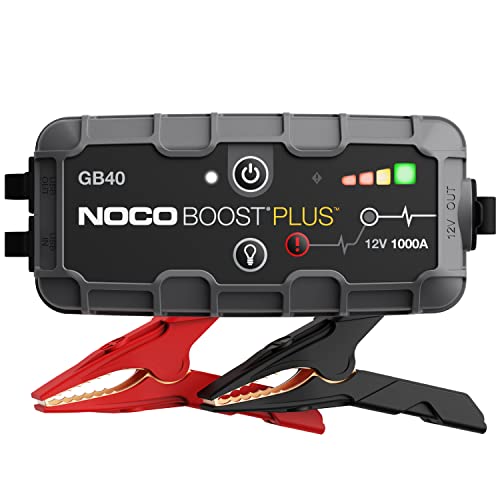
- Most cars and small SUVs (up to about a 6.0L gas engine): a 1,000–1,250A pack such as the NOCO Boost GB40 or NOCO Boost X GBX45.
- Full-size trucks, V8s and diesels: step up to a 2,000A-plus pack — the NOCO Boost GB70 or, for big diesels, the NOCO Boost X GBX155.
- One box for a flat battery and a flat tire: a jump starter with a built-in inflator, such as the GOOLOO A3 or the WOLFBOX 4000A with compressor.
- A vehicle that sits for weeks (classic car, motorcycle, mower, boat): a maintainer, not a jump starter — the NOCO GENIUS1 or Battery Tender Junior.
- Recovering a flat car or truck battery overnight: a 5A or 10A smart charger — the NOCO GENIUS5 or GENIUS10.
How to size a jump starter
Start with the engine, not the amp number. Every maker prints a peak-amp figure on the box, but there is no common standard for measuring it, so a “5,000A” pack from one brand is not automatically stronger than a “2,000A” pack from another. The more useful figure is the engine rating — the largest gas and diesel engine the maker says the pack will start. Diesels need far more cranking current than gas engines of the same size, which is why every pack lists a smaller diesel number.
Buy one size up from your biggest engine. Cold weather, an old battery and a pack that has sat in the trunk for six months all take a bite out of what actually reaches the starter. If you own a four-cylinder commuter and a diesel pickup, size for the pickup.
Then decide what else you want in the box. Nearly all of these double as a USB power bank and a flashlight. A built-in tire inflator adds bulk and cost, but it replaces a second tool — see our guide to what size air compressor a garage needs if you want proper shop air instead.
Jump starters compared
| Model | Maker’s peak rating | Rated up to (gas / diesel) | Built-in inflator | Also |
|---|---|---|---|---|
| NOCO Boost GB40 | 1,000A | 6.0L / 3.0L | No | USB power bank, LED light with SOS |
| NOCO Boost X GBX45 | 1,250A | 6.5L / 4.0L | No | USB power bank, multi-mode light |
| NOCO Boost GB70 | 2,000A | 8.0L / 6.0L | No | USB power bank, light; about 3.5 h to recharge |
| NOCO Boost X GBX155 | 4,250A | 10.0L / 8.0L | No | USB-A and USB-C power bank, light |
| GOOLOO A3 | 3,000A | 9.0L / 6.5L | Yes — 150 PSI, auto shut-off | USB ports |
| WOLFBOX 4000A with compressor | 4,000A | 10L / 10L | Yes — 160 PSI, digital gauge | 24,000mAh pack, 65W USB-C, light |
| WOLFBOX MV24 | 4,000A | 10L / 10L | No | 24,000mAh pack, 65W output, status screen, light |
| HALO Bolt Air | 500A | Not rated by engine size; “cars, SUVs and trucks” | Yes — 100 PSI | 58.8 Wh pack, USB-A and USB-C, floodlight |
| AstroAI S8 | 1,500A | 6.0L / 3.0L | No | USB ports, three-mode light |
| HPBS “H50” | 5,000A | 10.0L / 8.0L | No | 3-inch status display, USB ports |
| Sharmeal 5000A | 5,000A | 10.0L / 9.0L | No | LED light; no USB charging ports |
Ratings are the manufacturers’ own and are not measured to a shared standard. Check the current listing before you buy; specifications change without the model name changing.
For everyday cars: NOCO Boost GB40 and GBX45
The GB40 is the pack most people should start with. It is rated for gas engines up to 6.0L and diesels up to 3.0L, which covers the large majority of cars, crossovers and small trucks, and it is small enough to live in a glovebox. NOCO’s clamps are spark-proof and protected against being connected backwards — the mistake that matters most when you are doing this in the dark. The GBX45 is the newer equivalent with a little more headroom (6.5L gas, 4.0L diesel). The AstroAI S8 carries the same 6.0L gas / 3.0L diesel rating from a 1,500A pack and usually costs less, with a three-mode light and USB ports. The trade-off: none of these is the pack for a big diesel, and none inflates a tire.
For trucks, V8s and diesels: NOCO Boost GB70 and GBX155
The GB70 doubles the GB40’s rating — 8.0L gas, 6.0L diesel — and is the sensible size for a half-ton truck or a garage with mixed vehicles. If there is a heavy-duty diesel in the driveway, the GBX155 is rated to 10.0L gas and 8.0L diesel and charges from a wall adapter or a 12V socket. The trade-off: size, weight and price all climb with the rating; do not buy the big one “just in case” for a compact car.
With a tire inflator built in: GOOLOO A3, WOLFBOX, HALO Bolt Air
These fold two roadside tools into one. The GOOLOO A3 pairs a 3,000A-rated starter (9.0L gas, 6.5L diesel) with a 150 PSI inflator that stops at the pressure you set. The WOLFBOX 4000A is the larger option — 24,000mAh, a 160 PSI inflator with a digital gauge and 65W USB-C output that will charge a laptop; the MV24 is the same starter without the compressor. The HALO Bolt Air is the compact take: a 500A starter — enough for cars and smaller SUVs rather than big trucks — with a 100 PSI compressor, a 58.8 Wh power bank and a floodlight. The trade-off: a combined unit is bulkier than a bare jump pack, a small onboard compressor is slow on a truck tire, and if either half fails you have lost both tools.
High-claim budget packs: HPBS H50 and Sharmeal 5000A
Both advertise 5,000A and engine ratings as large as anything here, for less money than the big-name packs. Read those numbers with the caveat above: peak-amp claims are not comparable between brands. If you go this route, favour the listing with the longer review history, check what the warranty actually covers, and note that the Sharmeal has no USB charging ports. For a vehicle you depend on, the established brands’ engine ratings are the safer guide.
Chargers and maintainers: pick by amps
A charger’s amp rating is simply how fast it fills the battery. Low amps are gentle and ideal for keeping a stored battery full; higher amps recover a flat battery in hours rather than days.
| Model | Output | Works with | Best for |
|---|---|---|---|
| Battery Tender Junior | 0.75A | 12V lead-acid only (flooded, AGM, gel) | Long-term storage: motorcycles, mowers, a classic car |
| NOCO GENIUS1 | 1A | 6V and 12V; lead-acid and lithium | Maintaining small batteries; slow top-ups |
| NOCO GENIUS5 | 5A | 6V and 12V; lead-acid and lithium | The all-rounder for cars and SUVs |
| NOCO GENIUS10 | 10A | 6V and 12V; lead-acid and lithium | Trucks, large batteries, faster recovery |
The Battery Tender Junior is the long-standing set-and-forget maintainer: it charges, then drops to a float mode and holds the battery there. It is 12V lead-acid only — no lithium, no 6V. The GENIUS1 does the same job, adds 6V and lithium support, and adjusts its charge for temperature, which matters in an unheated garage. For a daily driver that has gone flat, the GENIUS5 is the size to own; the GENIUS10 halves the wait on a truck battery. All four are protected against reversed clamps and sparking.
Using them safely
- Read the manual for the pack and your vehicle. Some cars specify a remote jump post rather than the battery terminal.
- Never try to jump or charge a battery that is frozen, cracked, leaking or swollen. Replace it.
- Connect red to positive first, then black to the ground point the manual names. Disconnect in reverse.
- Lithium jump packs self-discharge. Top yours up every three to six months, or it will be flat on the day you need it.
- Heat shortens a lithium pack’s life. A trunk is fine; a dashboard in July is not. Check the maker’s storage temperature range.
- If the engine does not start after a few tries, stop. Repeated cranking overheats the pack and the starter, and the problem may not be the battery.
FAQ
How many amps do I need to jump start my car?
Use the engine rating, not the amp figure. A pack rated for a 6.0L gas engine covers most cars and small SUVs; trucks, V8s and any diesel need a pack rated for that engine size, with a margin for cold weather.
Will a jump starter recharge my battery?
No. It lends enough current to start the engine; the alternator then recharges the battery as you drive. If the battery goes flat again within days, it needs a proper charge from a wall charger, or replacing.
What is the difference between a charger and a maintainer?
Mostly speed. A maintainer (around 1A or less) keeps a healthy battery full during storage. A charger (5A and up) recovers a discharged battery in hours. Modern smart chargers do both: they charge, then switch to maintaining automatically.
Can I leave a maintainer connected all winter?
That is what they are designed for. A smart maintainer stops charging when the battery is full and tops it up only as needed. Check the clamps and the battery every few weeks all the same.
Is a jump starter with an air compressor worth it?
For an emergency kit in a daily driver, yes — it covers the two most common roadside problems in one box. For regular garage use, a separate inflator or shop compressor is faster and lasts longer.
How we chose
This guide compares manufacturer specifications, engine ratings and features across current listings, and sorts them by the job they suit. It is not a bench test, and no ranking here is influenced by commission rates — see our affiliate disclosure. Prices move constantly, so none are quoted; check the listing for today’s figure. For the rest of a home mechanic’s kit, see the best tools for working on your car at home.
