
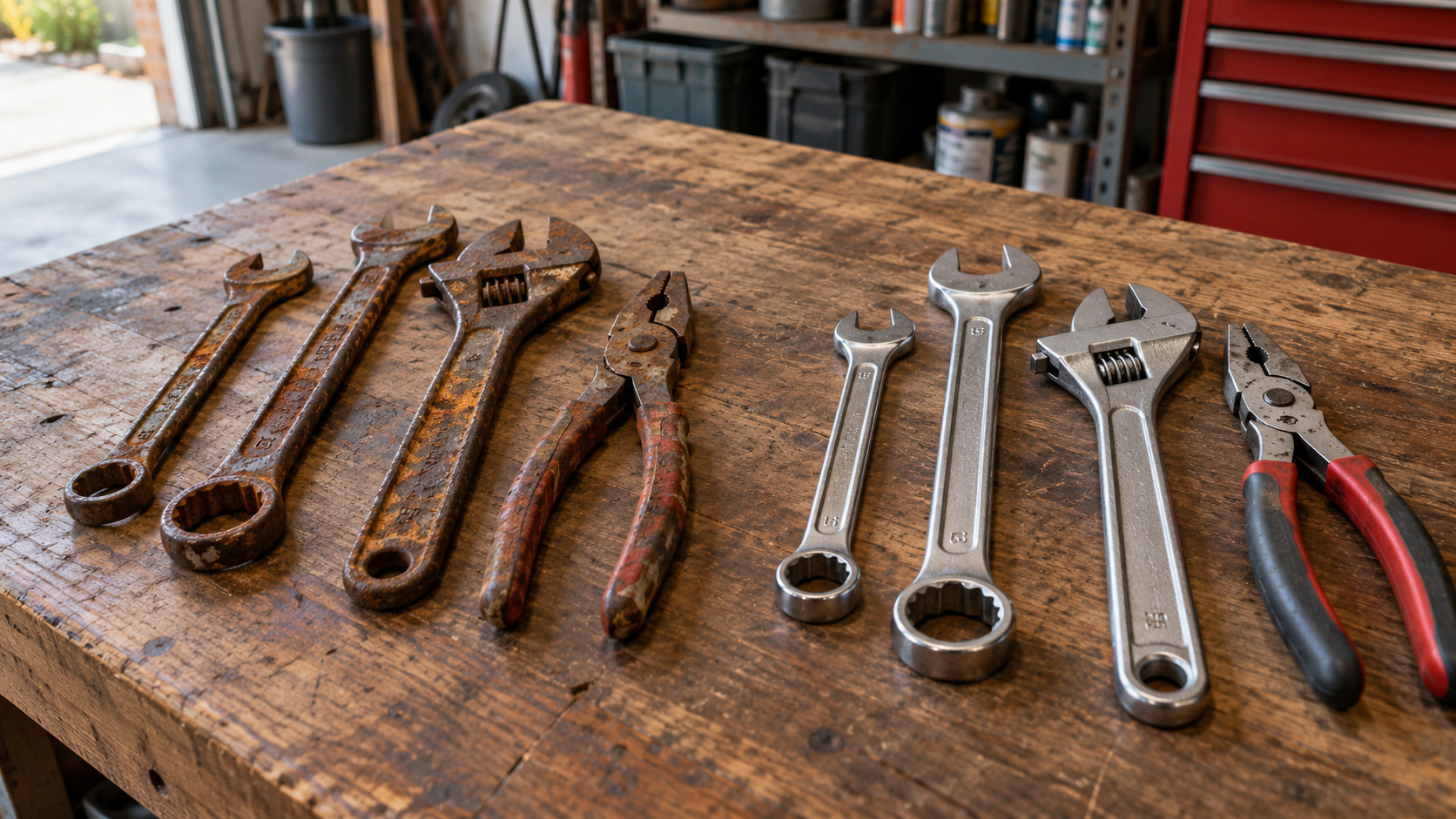
Rust in a garage is rarely about neglect. It is weather. Tools that have sat clean and dry all winter turn orange in a single April morning, and the person who owns them did nothing wrong except open the door. Once you see why that happens, the fixes sort themselves into an obvious order, and most of them are cheap.
What rust needs
Steel rusts when iron, oxygen and liquid water meet. Oxygen is everywhere, so the only thing you can control is the water. It does not have to be visible. A film a few molecules thick is enough, and that film forms on clean steel once the relative humidity of the air around it stays above about 60 percent. On steel that carries salt, dust or fingerprints it forms at lower humidity, because those deposits pull water out of the air. That is why a tool rusts first where you held it.
Below about 50 percent relative humidity, corrosion on indoor steel slows to almost nothing. That number is the target for the rest of this guide.
Why it happens overnight: dew point
Relative humidity describes the air. Rust happens on the metal, and the metal is often at a different temperature from the air.
Warm air holds more water vapour than cold air. Cool any parcel of air and its relative humidity climbs; at some temperature it reaches 100 percent and water condenses. That temperature is the dew point. Any surface colder than the dew point of the air touching it gets wet, exactly as a cold drink does in summer.
A close-enough estimate when humidity is above 50 percent:
Dew point (°F) ≈ air temperature − (100 − RH) × 0.36
Take a mild spring morning at 70°F and 65 percent humidity. The dew point is about 70 − 12.6 = 57°F. Your table saw’s cast iron top, your vice and the 400 lb of tools in a steel chest spent the night at 45°F and, being heavy, are still at 48°F at ten in the morning. You open the garage door. Air with a 57°F dew point rolls across metal at 48°F, and every surface sweats. Nothing leaked. No one spilled anything. By evening there is a bloom of rust on bare cast iron.
This is why rust is seasonal, why heavy tools suffer more than light ones, and why an unheated garage in a humid climate is harder on tools than a shed in a desert that sees far bigger temperature swings. It also points at the two general cures: lower the dew point of the air (dry it), or keep the metal warmer than the dew point (insulate, or heat gently). Everything practical is a version of one or the other.
Measure before you buy anything
A digital thermometer-hygrometer costs about as much as a can of spray lubricant. Buy one that records minimum and maximum readings, put it at bench height away from the door, and look at it for a couple of weeks. Better ones display dew point directly.
- Mostly under 50 percent: the air is not your problem. Skip to the section on protecting the tools themselves, and look for a local cause such as a wet car or a leak.
- 50 to 65 percent, with spikes: typical. Source control and tool-level protection will probably do.
- Over 65 percent for days at a time: you need to dry the air, which means a dehumidifier, and it is worth tightening the building first so you are not drying the neighbourhood.
Find the water
Garages collect moisture from more places than people expect. In rough order of how much water they add:
The car
A car driven in rain or snow carries in water by the gallon, on the body, in the wheel arches and packed into the underside as slush. In winter it carries road salt as well, which dries to a dust that settles on everything and lowers the humidity at which steel starts to corrode. Knock the slush off outside, squeegee meltwater out of the door rather than letting it evaporate indoors, and use a containment mat under the car if the floor does not drain. If the tools matter more than the car, park the wet car outside.
Unvented combustion heaters
Propane and kerosene heaters that exhaust into the room make water as a product of burning. Every gallon of propane burned releases about 0.8 gallons of water as vapour; kerosene releases about a gallon per gallon. A torpedo heater is a humidifier that also makes heat. It warms the air fast and the heavy steel slowly, which is the exact recipe for condensation. Electric heat, or a vented gas unit heater, adds no moisture at all. There is more on heating and cooling options in our garage climate control guide.
The slab
Concrete is porous, and many garage slabs were poured without a vapour barrier underneath. Ground moisture moves up through them continuously. The test is simple and standard: tape an 18-inch square of clear plastic to the bare floor, sealed on all four edges, and leave it for a day. Moisture under the plastic, or a darkened patch of concrete, means vapour is coming through. A penetrating silicate sealer reduces it, and a properly applied epoxy or polyaspartic coating reduces it further; both are covered in garage floor coatings vs tiles. Either way, do not store steel in contact with the floor. Put chests on casters and everything else on shelves.
Rain and ground water
Look at the bottom door seal, the corners of the door opening, the sill plate and any wall below grade. Gutters that discharge next to the garage and a driveway that slopes toward the door are the usual culprits. A threshold seal glued to the floor under the door stops wind-driven rain for very little money.
Appliances
A clothes dryer venting into the garage, even partly through a loose duct, will overwhelm any dehumidifier. So will a utility sink, a washing machine and a water heater’s relief drip to a lesser degree.
Tighten the building
Insulation does not dry anything. It slows temperature swings, so that the steel inside spends less time colder than the incoming air, and it lets a dehumidifier or heater work on a fixed volume of air instead of a continuous supply from outdoors.
- The door is the largest and leakiest surface. An insulated sectional door with intact perimeter seals is the biggest single improvement. Retrofit foam panel kits help an uninsulated steel door a little.
- Weatherstrip the side door and seal obvious gaps at the sill and around penetrations.
- Insulate the ceiling if there is attic above, and the walls if they are open.
Ventilation needs a caution. The idea that moving air prevents rust is half right. Bringing in outside air helps only when that air has a lower dew point than the air inside. On a humid summer day, a fan pulling outdoor air across cool tools is delivering water to them. Ventilate on dry days and after bringing in a wet car. Close up on muggy ones. Exhaust fans with a dew-point controller do this automatically; a plain humidistat fan does it wrong about half the time.
Dehumidifiers: the type matters more than the size
If the hygrometer says the air is the problem, a dehumidifier set to 45 to 50 percent is the reliable fix. There are two kinds and they suit different garages.
| Compressor (refrigerant) | Desiccant (rotor) | |
|---|---|---|
| How it works | Chills a coil below the dew point; water condenses on it | A wheel of moisture-absorbing material is dried by a small heater |
| Best temperature range | Above about 60–65°F | Any, down to near freezing |
| In the cold | Capacity falls steeply below 60°F; coil ices up in the 40s, and the unit spends its time defrosting | Output barely changes |
| Energy use | Lower per pint in warm conditions | Higher; gives off more heat, which in a cold garage is welcome |
| Typical home sizes | 20 to 50 pints per day | About 13 to 20 pints per day |
| Suits | Warm humid climates, summer use, attached and partly conditioned garages | Unheated garages in cool damp climates, winter and shoulder seasons |
The rated capacity of a compressor unit is measured at 65°F and 60 percent humidity under the current US test standard. In a 50°F garage the same machine removes a fraction of that. Many people conclude that dehumidifiers do not work in garages when what they have is the wrong type for the season.
Practical points:
- Size: for a closed two-car garage in a humid region, a 35 to 50 pint compressor unit is the usual choice. Oversizing costs little and shortens run time.
- Drain it continuously. A bucket fills in hours in summer and the unit shuts off when it does. Run the hose to a floor drain or outside, or buy a model with a built-in condensate pump if the water has to go uphill.
- Keep the door shut. A dehumidifier in a garage with the door open is pumping water out of the outdoors.
- Expect a running cost. A 500-watt unit running half the time uses about 6 kWh a day. Set it to 50 percent rather than 35; the last few points cost the most and buy nothing.
- Clean the filter, more often than the manual says. Garage dust is worse than house dust.
Gentle heat, where drying the room is not practical
A closed steel cabinet or tool chest can be kept a few degrees above the surrounding air with a very small heater, and a few degrees is all it takes to stay above the dew point. Low-wattage heating rods sold for gun safes, in the range of 10 to 40 watts, do this safely and continuously. It is the modern form of the old machinist’s trick of leaving a light bulb burning in the bottom of the toolbox, which no longer works now that bulbs run cool.
For a single large machine, a magnetic engine-block heater on a thermostat or a low-wattage heating pad under a cover does the same. These approaches use far less power than drying a whole garage and are worth considering if the tools that matter are few and heavy.
Protecting the tools themselves
With the air under control, surface protection becomes a second line of defence. In a garage where the air cannot be controlled, it is the first.
Clean first
Wipe tools down before putting them away, especially after handling them with sweaty hands. Sweat is salt water. A rag kept slightly oily for this purpose, stored in a closed metal tin, is the single most effective habit in this article. Sawdust left on cast iron holds moisture against it; brush it off.
Oils, waxes and sprays
| Type | Examples | Good for | Limits |
|---|---|---|---|
| Light machine oil | 3-in-One, sewing machine oil, camellia oil | Hand tools, plane soles, chisels, measuring tools | Thin film; renew every few weeks in a damp garage |
| Water-displacing spray | WD-40 Multi-Use | Driving water off a tool that got wet | Evaporates in days. It is a first step, not a rust preventive |
| Wax-film protectant | Boeshield T-9, CRC 3-36, WD-40 Specialist Corrosion Inhibitor | Machine surfaces, stored tools, anything left for months | Leaves a slightly tacky film that has to be wiped from working surfaces before use |
| Paste wax | Any furniture paste wax without silicone | Cast iron tops on table saws, jointers, band saws, drill presses | Reapply every month or two. Avoid silicone in a woodshop; it ruins finishes |
| Lanolin-based coating | Fluid Film | Long-term storage, trailers, garden equipment, vehicle underbodies | Stays wet and collects dust; has a smell |
Vapour corrosion inhibitors
VCI products release a vapour that settles on metal as a layer one molecule thick and blocks the reaction. They come as drawer liners, paper, plastic bags and small emitter capsules that stick inside a drawer or case. In a closed space they work well and last a year or two. They do nothing in an open room, because the vapour drifts away. A VCI emitter in each drawer of a closed tool chest is cheap and needs no attention until it expires; write the date on it.
Desiccants
Silica gel absorbs water until it is saturated and then stops. In a sealed container, such as a gasketed plastic case or an ammunition can, a good-sized pack keeps the contents dry for months, and the kind with a colour indicator can be dried in an oven at about 250°F and reused. In a tool-chest drawer, which leaks air all the time, a small packet is saturated within days. Use desiccant for sealed cases and VCI for drawers.
Storage choices that cause rust
- Leather sheaths and rolls hold moisture and the tanning chemicals are mildly corrosive. Fine for carrying, poor for storage.
- Cardboard boxes absorb water from the air and hold it against whatever is inside.
- Open-cell foam does the same. Closed-cell foam organisers, as used in tool-control drawers, do not.
- A plastic sheet over a machine traps condensation underneath. Use a breathable fabric cover, or wax the surface and leave it uncovered.
- Tools on a concrete floor sit in the dampest, coldest layer of air in the room.
Closed drawers help more than it seems. A steel chest is not airtight, but it slows the exchange of air enough that the tools inside never meet the blast of humid air that comes with an opening door. Chest options are compared in Husky vs Icon vs US General, and layout in the garage tool storage setup guide.
Power tools, batteries and compressors
- Corded and cordless tools condense internally just as hand tools do externally. A tool brought from a cold garage into a warm house will sweat inside; let it warm up in its case before use. Blow dust out of vents, since dust holds moisture against windings and switches.
- Lithium-ion batteries last longest stored between about 40 and 80°F at partial charge, and should not be charged below freezing. In a climate with real winters or very hot summers, the batteries and chargers are better kept indoors. The tools can stay.
- Air compressors rust from the inside. Compressing air squeezes the water out of it, and that water collects in the tank. Open the drain valve after every use until it blows dry. A tank that is never drained loses wall thickness where you cannot see it, and tanks do fail. More in best garage air compressors and how to size one.
- Air tools need a few drops of air-tool oil in the inlet before each use, because the air that drives them is wet. A filter and water separator at the compressor helps everything downstream.
Getting rust off
Match the method to the depth of the rust and the value of the surface.
- Light surface bloom: oil and a grey synthetic abrasive pad or 0000 steel wool, rubbed with the grain of the finish. On cast iron tops, a pad under a random-orbit sander with a little mineral spirits is quick. Wipe clean, wax at once.
- Chelating rust remover (Evapo-Rust and similar): a water-based soak that removes rust without attacking sound steel, paint, plastic or skin. Soak for a few hours to overnight, rinse, dry and oil. It can be reused until it turns black. For hand tools with moderate rust, this is the best general method.
- White vinegar or citric acid: a cheap soak that works in 12 to 24 hours. It is an acid, so it also etches good steel slightly and will strip bluing and some platings. Rinse, neutralise in a baking soda solution, dry immediately and oil; acid-cleaned steel flash-rusts within minutes if left wet.
- Electrolysis: for large or intricate cast iron parts. A plastic tub, washing soda in water, a sacrificial steel anode and a manual battery charger. It removes rust from places nothing else reaches. It produces hydrogen, so do it outdoors, and never use stainless steel as the anode.
- Wire wheel: fast, and fine on rough castings and hardware. It will smear and round over machined surfaces and edges. Eye protection every time; wheels shed wires.
- Rust converters turn rust into a stable black layer that takes paint. They are for trailers, frames and railings. They are not for tools with working surfaces.
Pitting is permanent. A pitted wrench works as well as ever. A pitted plane sole or chisel back has to be lapped flat past the pits, and a pitted measuring surface is finished. The cost of rust is unevenly spread, which is a good guide to where to spend your prevention effort.
A plan, by budget
Almost free
- Hygrometer on the bench.
- Oily rag in a tin; wipe tools before they go away.
- Paste wax on cast iron.
- Everything off the floor and out of cardboard.
- Squeegee meltwater out; stop using an unvented heater.
Under about a hundred dollars
- VCI emitters or liners in every tool-chest drawer.
- Gasketed cases with rechargeable silica gel for precision and measuring tools.
- A can of wax-film protectant for machines and anything stored for the season.
- New bottom seal and a threshold strip for the door.
A few hundred dollars
- A dehumidifier of the right type for your climate, drained continuously, set to 50 percent.
- A low-wattage heating rod in the main tool cabinet.
- Seal the slab if the plastic-sheet test showed moisture.
When you next replace the door or renovate
An insulated door, insulated walls and ceiling, and a vented or electric heater. At that point the garage behaves like a room and the dehumidifier hardly runs.
Frequently asked questions
What humidity should a garage be to stop rust?
Under 50 percent relative humidity, measured at bench height. Between 50 and 60 is tolerable for tools that are wiped down and kept in closed drawers. Above 60 for long periods, bare steel will rust.
Will a dehumidifier work in an unheated garage in winter?
A desiccant type will. A compressor type loses most of its capacity below about 60°F and ices up in the 40s. In many climates winter air is dry enough that neither is needed until spring.
Does WD-40 prevent rust?
The ordinary blue-and-yellow can displaces water well and protects for days, not months. For storage, use a product made as a corrosion inhibitor, an oil, or wax.
Do silica gel packs in a toolbox work?
Only if the box seals. In an ordinary chest they saturate quickly. VCI emitters suit drawers better.
Is it better to leave the garage door open to air it out?
On a dry day, yes. On a humid day it makes things worse, because the incoming air condenses on cool tools. Check the dew point, not the temperature.
Why do my tools rust in one drawer and not another?
Look for a source in that drawer: a leather pouch, a cardboard box, a wet rag, a tool put away with sweaty fingerprints, or an open-cell foam liner. Rust in one place nearly always has a local cause.
Related: the complete home garage tool setup guide · garage wall storage systems · choosing a power tool brand.
